Low Involvement = Low Engagement

Successfully starting and running a business also means, in most cases, successfully dealing with people. These can be the people who work within the company or those who interact with the company externally. Involvement plays a central role in dealing with these people. Entrepreneurs should know their most important stakeholders and, optimally, also take an active approach to the involvement of these groups.

Successfully starting and running a business also means, in most cases, successfully dealing with people. These can be the people who work within the company or those who interact with the company externally. These different groups of people are typically also called stakeholders. The most relevant stakeholders are most likely employees, customers, suppliers and creditors, as well as shareholders.

Involvement plays a central role in dealing with all stakeholders. Entrepreneurs should know their most important stakeholders and, optimally, also take an active approach to the involvement of these groups.

Involvement is equated with engagement in many companies and professional articles. If one takes a closer look and wants to focus more on the activities of the company, a separate consideration makes a little more sense. Involvement is a form of participation that encourages active involvement and refers to the involvement of one or more individuals. Therefore, when we speak of involvement, we are referring to the activities, measures, and conditions that a company must take or create to generate a high level of commitment from customers or employees. Engagement, as a form of personal involvement or commitment, is therefore the result of involvement.

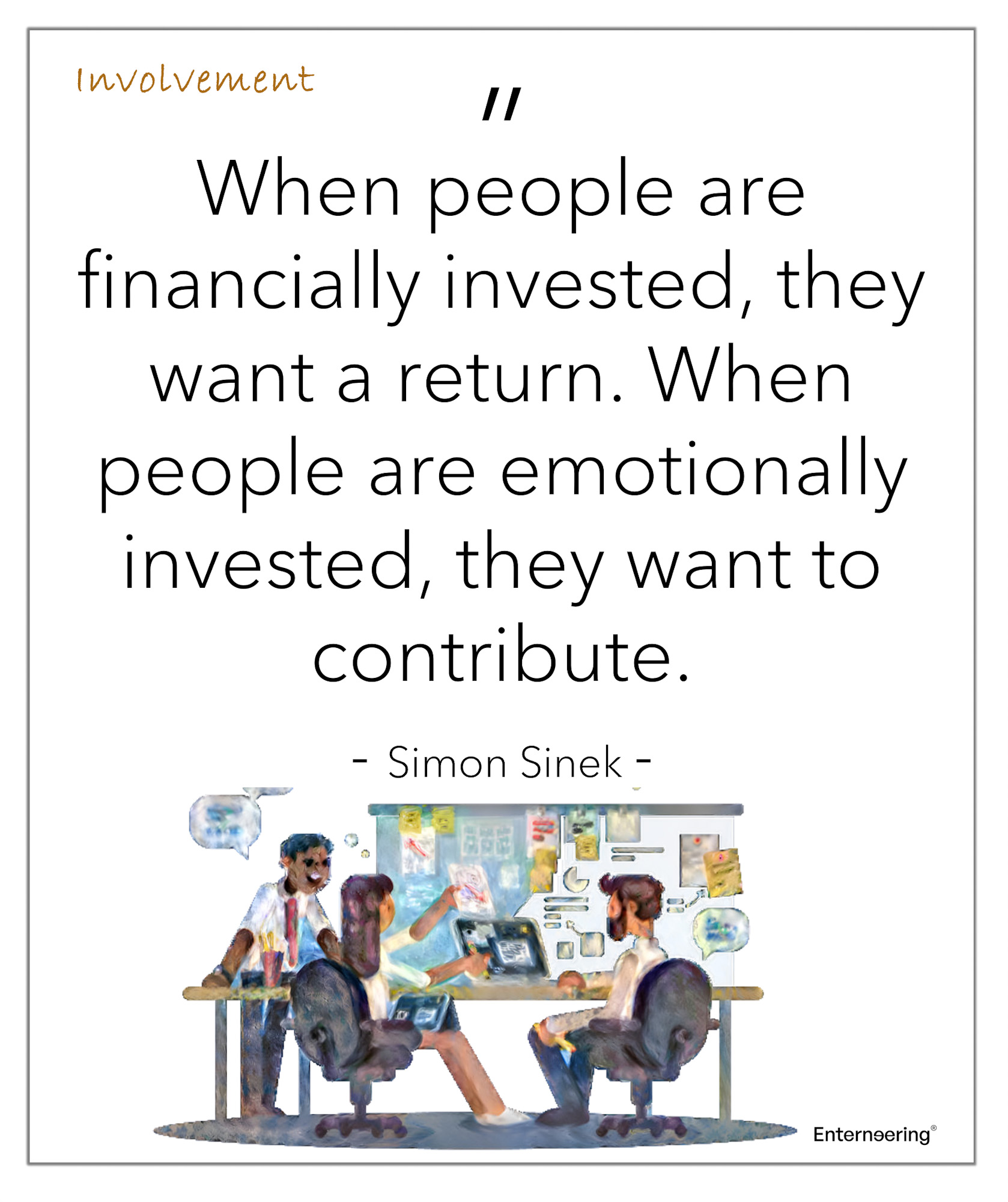
Involvement is the degree to which an individual or group is willing to engage with a particular issue or environment. In the professional world, a distinction is often made between high involvement and low involvement. Involvement is a component of human interaction that needs to be understood as thoroughly as possible and, ideally, used in a targeted way.
qoute_involvement_edited

Companies usually want to ensure that certain people are willing to engage particularly intensively and persistently with a topic, a product, or the company itself. Sometimes, companies are also urged to interact with stakeholders. These can include trade unions and authorities, as well as banks and interest groups. In these cases, it is also useful to be aware of and employ the fundamentals and mechanisms of involvement.

Basically, we can talk about two forms of involvement:

  • ‘Personal involvement’ is based on the individual inclinations and values of a person or a group of people. It automatically develops when people's basic needs or interests line up with the company, its culture and its products. Personal Involvement, therefore, is usually characterised by a long-term and sustained interest.
  • ‘Situational involvement’, on the other hand, arises when people's needs and interests line up with individual topics, products, or activities of a company on a temporary basis or in phases, depending on their own life situations.

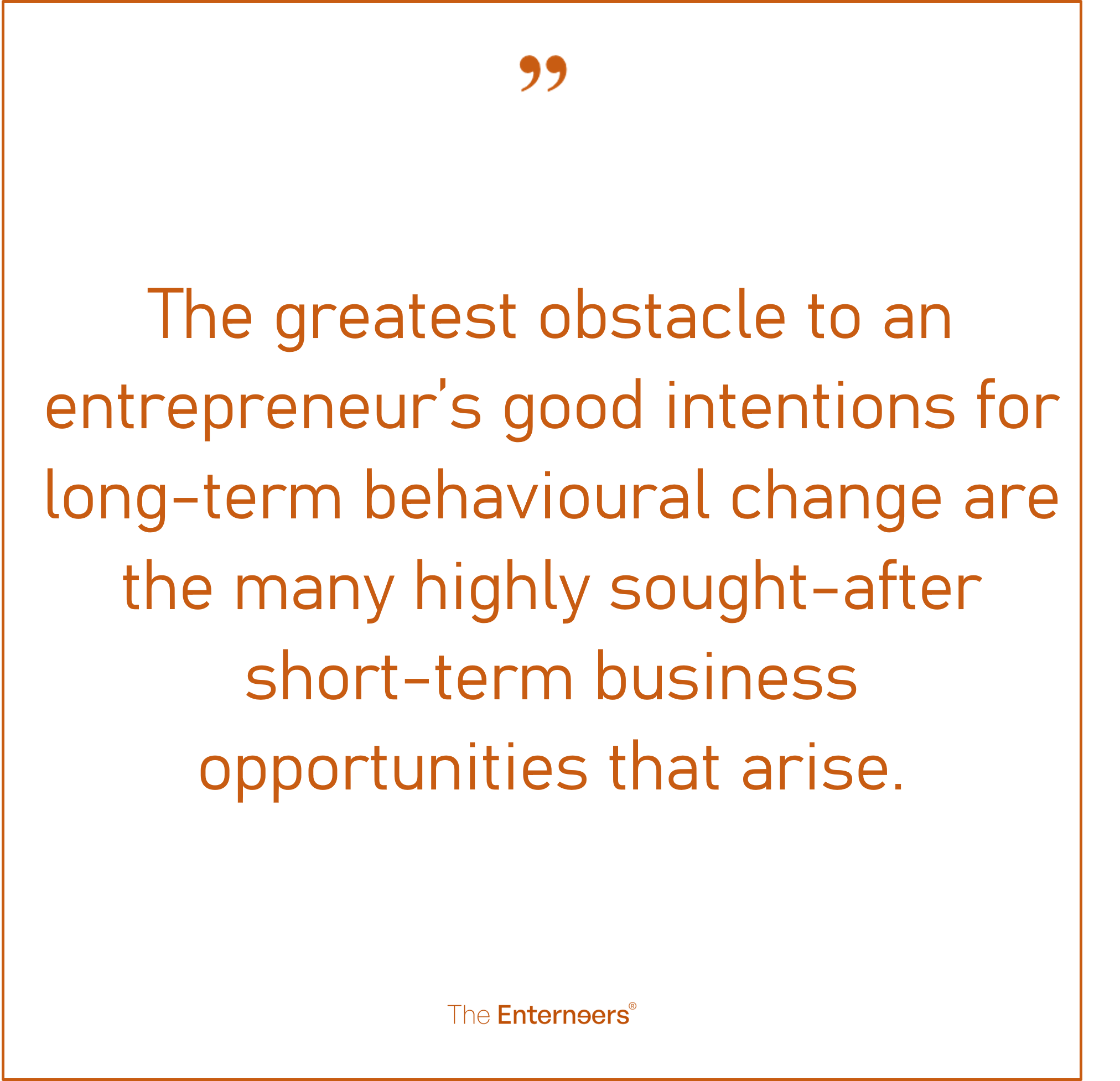
It is important to understand that, depending upon the degree of complexity, involvement can also develop or diminish even in the absence of active involvement management. This may lead to positive situations for the company, but it does not necessarily do so. It can also lead to very disadvantageous situations. Involvement, therefore, is something entrepreneurs should not leave to chance when it comes to their most important stakeholders.

The benefits of active involvement strongly depend on which stakeholders are involved. Employees can be tied more closely to the company or to individual projects through active involvement. This usually leads them to take a greater interest in their own work and the benefits or success of their own work. This in turn leads to increased motivation, further growth and willingness to perform. With customer groups, active involvement can also lead to an increase in customer loyalty, demand and willingness to buy. But even with stakeholders who are less closely tied to the company, targeted involvement can lead to positive communication and decisions, such as in intentionally partnership-based collaborations with works councils or banks.

In this digital age of overstimulation and information overload, it is not very useful to simply reach out to stakeholders frequently, using every communication tool in the company arsenal. Despite the high flow of information, people are very capable of selection. It is precisely at times like these that humans continue to develop these skills. They filter messages according to individual patterns – and what is crucial in this filtering is the type of involvement involved.

The basic rules of interaction with stakeholders in the two categories of high and low involvement can be outlined as follows:

graph_involvement_en
Employee Involvement

It is not enough to find and hire the best talent and then send those people to training. For employees to use their talents properly and realise their full potential, they must have a lasting intrinsic interest in the company or in what they themselves are doing. This interest comes from involvement. And, depending on the personality structure of the individual, employees can also be divided into categories of high and low involvement. To achieve optimal motivation, retention and performance, it is important to involve employees in important areas of the company and to create a positive culture.

Employee involvement means that employees are able to become personally involved in helping their company fulfil its mission and achieve its strategic goals. They can contribute their own ideas, expertise and individual approaches to the tasks at hand.

Employee involvement refers primarily to the work structures and processes that enable employees to systematically influence planning, preparations and decisions that affect their own work. It is therefore primarily a matter of having influence and helping to shape processes, and less about fundamental strategic decisions. Employees need to know about and understand these decisions in the first place to be able to develop their own involvement.

To enable successful involvement, employees should be allowed to participate in process-related decisions. They must have the appropriate skills and authority to do so, and there must be sufficient interaction as well as incentives to participate.

Elements of Employee Involvement

What steps do companies need to take to keep employee engagement high? Some companies still believe that offering as many material amenities as possible, such as fresh fruit every day, barista specialities, fitness classes, and company bikes with trendy event formats and cool organisational names, will lead to sustained high engagement. However, in Enterneering®, the answer is clear: successful companies are those that understand the elements of Enterneering® and have implemented them in their organisation appropriately. Therefore, no additional methods, approaches, or exercises are needed to successfully address the topic of involvement or engagement. In a way, positive engagement among employees and customers alike is one of the direct results of Enterneering®. The following elements have a direct effect on engagement:

Effective companies around the world understand the importance of employee involvement at all levels of the company. Some common elements are:

  • Participation in continuous improvement teams
  • Participation in quality workshops, quality control circles
  • Self-organised (agile) ways of working
  • Open dialogue on work management issues, workplace design
  • Interactive dialogue on strategy and its implementation progress
  • Creative freedom and workshops alongside day-to-day business
  • Regular, authentic meetings and workshops with management

Finally, there is another characteristic that lies in the behaviour of those with special responsibility in the company: authenticity. Only those companies in which the top management authentically and credibly exemplifies and demands the elements of Enterneering® will have lasting and thus sustainable success in the commitment of their employees, and presumably, their customers as well.

Note to entrepreneurs and intrapreneurs on the practical application of this: With a far-reaching involvement approach, care should always be taken that employees are not put in situations where they may act beyond the limits of their own abilities and competencies. If employees are involved in deliberation and decision-making processes for which they do not have adequate qualifications, experience and competence, unwanted stress situations can quickly arise. Last but not least, in cases where this occurs, approaches or decisions developed from within the staff are subsequently relativised or changed by other people who are ultimately responsible for them. This quickly leads to frustration on all sides and works against the actual goal of involvement. Involvement should not be confused with grassroots democracy. In the end, business decisions and approaches are the personal responsibility of management and owners. Involvement must not lead to this becoming a subject of negotiation.

clickButtonEE_thumb
More about People Management

How to Organize a Company

Among the primary tasks for corporate management, alongside the implementation of corporate culture and the further development of both it and the company’s employees, is the organisation of the company. It is important to understand that what is meant here is specifically not the organisation of individual units, projects, processes, or customer relationships, but the overall functioning of the company as an organism.

Among the primary tasks for corporate management, alongside the implementation of corporate culture and the further development of both it and the company’s employees, is the organisation of the company. It is important to understand that what is meant here is specifically not the organisation of individual units, projects, processes, or customer relationships, but the overall functioning of the company as an organism. In companies with multiple management levels, the details should always be worked out at a lower level, not by corporate management or the executive board. This is the point at which, in many companies, the lines of responsibility and action become inconsistent or blurred. This article will explain why this happens and why it is so important to eliminate specific habitual patterns.

Entrepreneurs who are not able to consciously distinguish between the individual elements and levels of their organisation will find it understandably difficult to determine where they should or must devote more of their own attention and where they should or must delegate. It is clear that not every element or level of the organisation requires the same amount of attention from the entrepreneur. It is also true that not every possible element or level of the corporate organisation should or can be equally applied overall. To determine which elements and levels should be applied in a specific situation – and to what extent – entrepreneurs must have a basic familiarity with these elements and be able to categorise them.

A significant phenomenon that often occurs during the organisational or structural work being carried out by a company is that as the direct involvement of managers and executives in a particular element decreases and the element becomes increasingly more generalised or long-term in nature, their interest and commitment to the specific element decreases. This can be clearly observed, for example, with the element ‘strategy’. While initially, nearly all participants indicate a high interest in strategy development, the attention and interest of the majority often wane during the operationalisation and implementation of their own strategy. One reason for this is the fact that during implementation, operational and tactical influences, disruptions and distractions repeatedly compete for attention or lead to a non-reflected change of priorities. Why does this happen? Because a specific problem or customer or order is so critical right now, and the strategy development, which is targeted at the medium to long term, is easier to put off, halt or divert. This is precisely the point where experienced and consistent management is required to ensure that the strategy (or any other important element) is so firmly anchored within the team and among the executives that its relevance is continuously retained. Management must strike the correct balance between dealing with spontaneously occurring events or requirements and working on long-term goals, and they must actively demand and exemplify it. For many entrepreneurs, this is an enormous personal challenge that must be consciously mastered.

OnvsIN_Organisation

If no or too few people with real decision-making power remain involved during the implementation of such essential elements, ensuring they are given sufficient attention and that the work continues, delegation of corporate responsibility quickly becomes invalid or even non-functioning. In the above example, in a worst-case situation, responsibility for implementing strategy would lie with the Head of Strategy/Development, who, although technically the responsible and presumably relevant intermediary, coordinator and administrator of the strategy and implementation plan, has no decision-making authority within the individual business units or in executive management.

Along with all the effort involved, in corporate practice, the personal interests, strengths and incentives of the individual managers frequently play a role. People who find more enjoyment in a specific business process, an individual project, or their own area of expertise, and find these closer to their interests, are likely to more quickly lose their desire in and commitment to a company-wide action. Here, too, entrepreneurs and executive management are called upon to strike a balance and ensure that higher-level goals are achieved.

To approach this topic in an appropriate and honest manner, the following simple rules can be helpful:

  • Correctly assess the importance of an element and take your time! Failure to correctly assess yourself, the topic or its importance and treating it as a side issue will ultimately lead to your own failure.
  • Ensure that you have a basic understanding of the situation; only if you have understood the various elements and levels involved will you be able to implement them successfully.
  • Address a smaller number of elements and levels and give these more attention and consistency.
  • The journey is the destination; many elements can be enhanced subsequently and do not have to start off as ‘best in class’.
  • Consider the culture and maturity level of people with particular responsibility within the company; the best or most ‘cool’ structural element is of no use if it doesn’t correspond to how people think and act.
  • Define and adhere to the sequence and priorities between the selected elements; the notorious parallelization of what are essentially important measures quickly leads to stagnation.

Finally, there is the question of for which companies, and of what complexity or size, the entire topic above is (still) at all relevant. Or is this question moot because certain elements play a role in every company? There are probably no universal formulas, key figures or benchmarks for this. The most unhelpful answer to this would probably be the legendary "it depends..." because, even though it may actually be the correct answer, it doesn’t bring us any further. What would appear to be more useful is a brief self-assessment, in which the most important elements and levels of a company's organization are documented in terms of their content and immediate significance and compared with the current company situation. Ideally, a short GAP analysis would still be able to be created from this, which would help in developing an understanding and initial categorization of relevance and reality.

The crucial elements and levels of corporate organization include:

Philosophy

Companies need to be able to blend the essential components of the corporate culture with a description of the company's future path and goals. These core elements are key for developing strategy and are important as a central overarching guiding principle for the management of a business as well as its long-term alignment.


Strategy

Companies need a plan for how, or in what steps, it will achieve its long-term goals. It is essential that this plan be operationalized and converted into a kind of roadmap. The strategy must be both clear to employees and relevant to their work so that they can identify with it as closely as possible.


Governance

Governance is the combination of rules, processes and laws by which businesses are operated, regulated, and controlled. It is a commitment to ensuring that accountability, diversity, transparency, and fairness are upheld at the company. The goal is to enhance business performance while increasing market access.


Innovation

Innovative capability and innovative strength are important factors for success. Entrepreneurs should know the basics and be aware of what is required to create and maintain an innovative environment and increase innovative strength. They must be able to define appropriate measures and deploy the right people.


Network

Networking involves developing and maintaining contacts that can help a business meet its needs. An important consideration for entrepreneurs is the strengthening of their networks. Being at the right place at the right time, talking to the right people and making the right impression, is key.


Growth

Growth is at the core of many corporate strategies. The ways in which companies increase their revenue or volume are many and varied. Entrepreneurs need to understand which company-wide conditions are necessary and what is required to ensure that growth leads to the healthy development of the company.


Change

Successful entrepreneurs recognize which business elements need to be maintained and where changes need to be made. They know that change always involves both people and organizations. This calls for strategies aimed at effecting and controlling change as well as helping people adapt to change.


clickButtonEE_thumb
More about Company Organization

How To Develop Corporate Culture

Every company has its own culture, which is shaped by the individual people within the company as well as, to a certain extent, external third parties who interact with the company. The greater the position of power an individual holds, the greater their direct influence on how this culture is put into practice.

Successful entrepreneurs, therefore, will not leave the development of their company’s culture to chance or to the uncontrolled expansion of individual forces within the organisation.

Developing an individual corporate culture does not necessarily require intensive study or an infinite number of methods. There are countless professional articles available that describe different methods and experiences.

One cultural researcher is Geert Hofstede, who describes organisational culture as a collective mental programming that distinguishes the members of one group or category from those of others. He has established a model with four categories: ‘Values’, ‘Rituals’, ‘Heroes’ and ‘Symbols’. [More about this model]

Another pioneer in the field of organisational culture is Edgar H. Schein. He defines organisational culture as the sum of all common and taken-for-granted assumptions that a group has learned over the course of its history. His three-level model – ‘Basic Assumptions’, ‘Values & Norms’ and ‘Artefacts’ – serves as the starting point for later models of culture. [More about this model]

Also well-known for describing corporate culture is Edward T. Hall’s ‘iceberg model’. This iceberg-shaped model illustrates the connection between visible, easily accessible cultural characteristics and the hidden, invisible parts of cultural behaviour. [More about this model]

McKinsey consultants Tom Peters and Robert Waterman developed the “7S model”, in which three hard and four soft factors are described as pillars of success, and the interdependencies within corporate culture are shown. [More about this model]

quote03_en

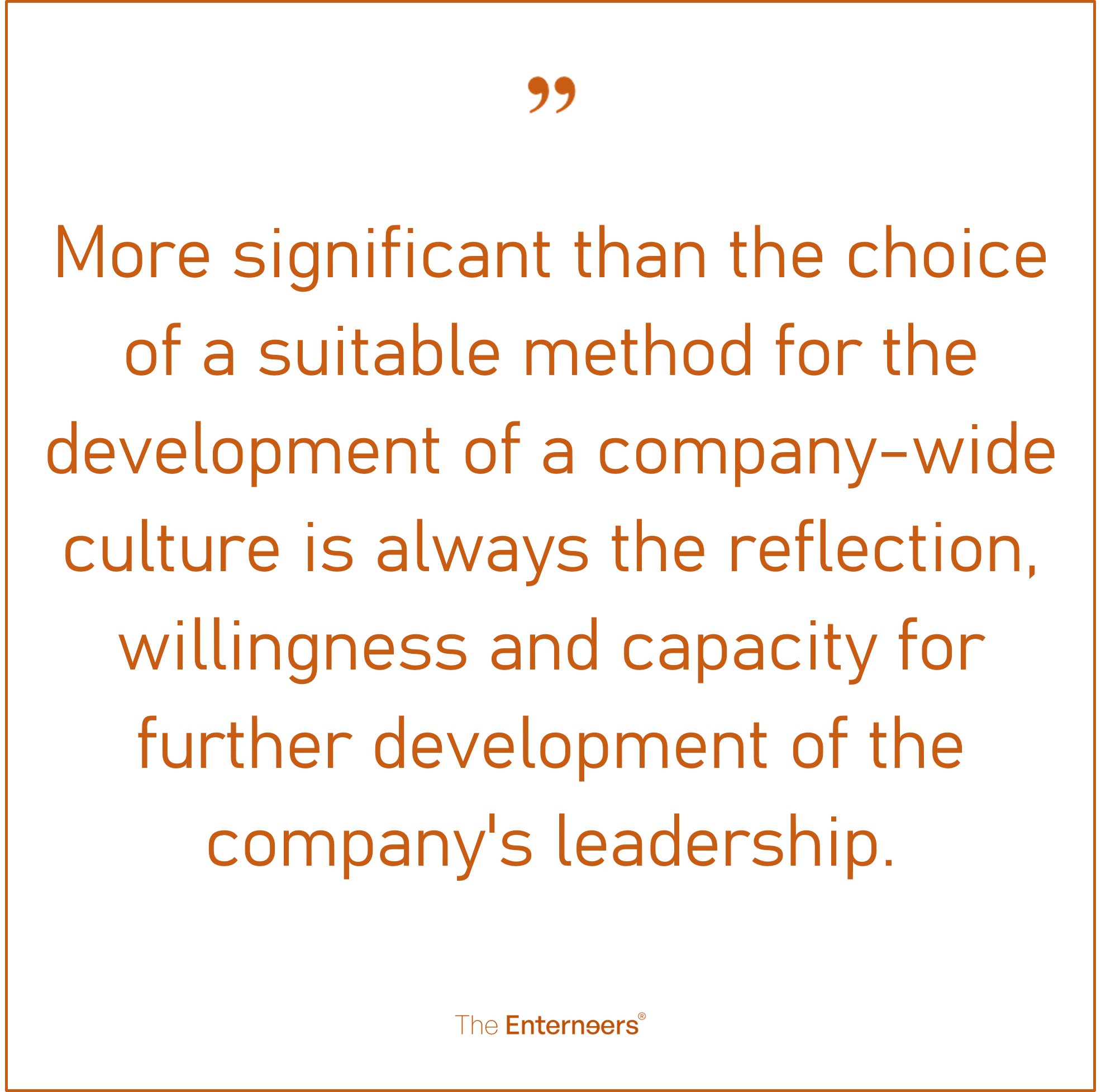
Methodologically speaking, there is thus something to suit every individual taste or situation. However, before applying or changing certain elements or approaches, the human aspects should be adjusted, first and foremost within the executive management itself. Although there is no patent recipe or commonly used blueprint for successful cultural development, the core elements of ‘awareness’, ‘courage’, ‘self-reflection’ and ‘action’ apply in almost any circumstance, method, or model for success.


Awareness

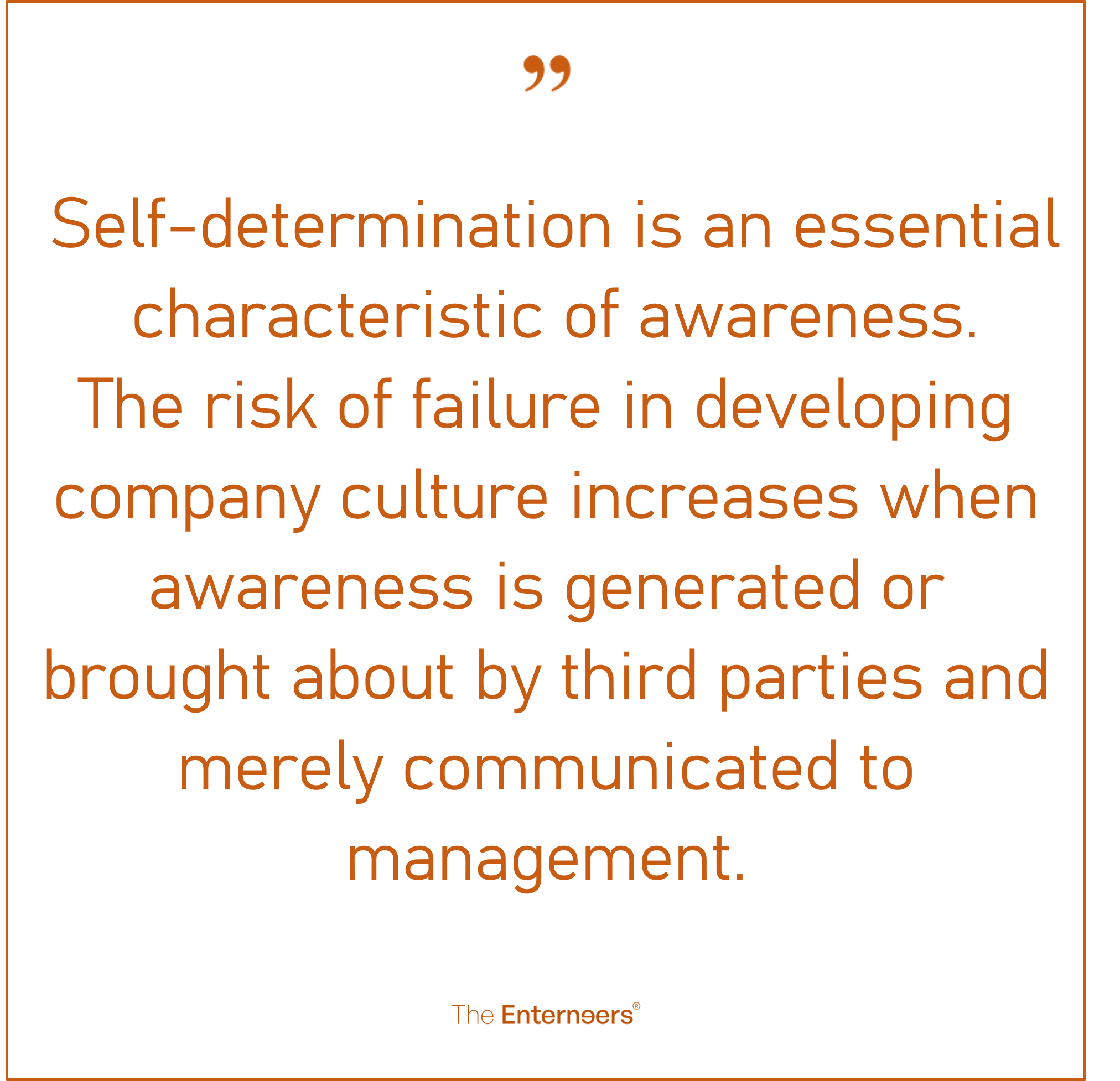
The path to awareness is paved with knowledge about the characteristics and significance of corporate culture as well as acceptance that the current form of any individual company’s culture has its weak points. Only those who understand how culture affects the people within a company and the consequences or changes that are associated with particular forms of cultural development can assess the situation in their own company. If management is also able to actively accept the potential for development, it will be able to tackle this a self-determined manner.

quote04_en

Courage

Courage is the lifeblood of every entrepreneur. Theoretically, there should be nothing else to add to this point. In practice, however, it is apparent that some entrepreneurs do not apply the same care and consistency to the topic of culture development as they do to making changes to an established product or their market image. This is probably because corporate culture is a topic that can relatively easily be moved to the back burner, but not one that can easily be simulated or calculated. It may therefore be considered a major unknown or uncertainty – and it is in constant competition with every other business process for attention and resources. This is exactly the point of the aspect of ‘COURAGE’, which is closely linked to a consistent risk consciousness.

It means having the courage to consciously adapt our own happily nurtured ways of thinking and behaving and remain authentic. The necessity of having the courage to consistently accept problematic ripple effects and interactions. In the end, it is also about having the courage to move forward with the times yourself, anticipating the future with an entrepreneurial mindset and paving the way for your organisation to get there successfully, even without being sure that you will always feel comfortable there yourself.


Self-Reflection

People all differ when it comes to their character, origin, upbringing, education, life experiences, preferences and personal development goals. All these aspects determine how individuals think and act. When it comes to the issue of developing an appropriate or desired form of corporate culture, contradictions or disagreement between those carrying out this task and the corporate ideal are not uncommon. The most important element for successfully resolving this debate is self-reflection.

  • What impulses for change can I establish myself?
  • How can my behaviour contribute to this new corporate culture I am part of?
  • How can I inspire others – am I communicating with other staff on the same wavelength?
  • What expectations do I have of the people in the company and am I an authentic role model?
  • How can the circle of those who do things differently become larger and larger?
  • Which people do I trust to play active roles as multipliers?

Although the term is ‘self-reflection’, enlisting appropriate third parties can be helpful. These may be life partners, people from your circle of friends and family, or trusted business partners. It is important that any such discussions be kept completely confidential and that open and honest feedback is expected.

Honest self-reflection can reveal that some of our own traits or behaviours are in conflict with specific elements of the company culture. For example, a person who places great value on tradition, performance and success will generally be strongly in favour of action-oriented planning and development and less focussed on team-oriented issues. Recognising and reflecting on constellations like these is an important step that should be taken before deciding on and implementing appropriate development measures.


Action

Regardless of whether the actions taken consist of personal measures, those of the management team or from within the workforce, they must always be planned. It is partly a matter of identifying and evaluating important interdependencies and interactions associated with the implementation of these actions. As with any task list or roadmap, the usual minimum requirements for these actions should also be described. In addition, for most actions, concurrent change management will probably be useful – and may even be an absolute necessity.

Public action should be integrated into the company's overall plan, because this also takes up resources, attention and energy. In addition, equivalent action planning promotes equivalent implementation and reduces the risk that culture development activities will be constantly pushed to the side in favour of business-related activities.

quote05_en

Personal actions should be itemized on a priority or to-do list, just like other strategic tasks. It also makes sense to share these personal tasks or goals with trusted people in your private life so that there is an opportunity for regular follow-up and feedback. Caution is advised, however, with any action that would require such a major change to your own patterns of thinking and behaviour that you risk a loss of authenticity or call your trustworthiness into question, or where your own discomfort might cause you to side-line your actual objective.


Within the framework of the principles described above, existing elements of today's culture can be evaluated, modified, or replaced and additional components adapted.[More about the elements of culture]

clickButtonEE_thumb
More about Corporate Culture

Vision, Mission, Strategy – Old Hat or Common Failing?

The topic is as old as industrial management theory itself, and yet many companies, whether start-ups or long-established businesses, struggle to successfully implement an integrated corporate philosophy and strategy. Why is that and what are the causes? The following article tackles these questions and the importance of sustainable strategic management.

Philosophy

Companies must be able to link the essential components of corporate culture to a description of the company's future path and goals. These core elements are key for strategy development and critical as a central, overarching guiding principle for the management and long-term direction of the company. This may sound quite pompous and theoretical, but these can nevertheless be intelligently defined in practice in accordance with the size or complexity of the company. This is because, at its core, it is about setting down in writing why a company exists, what benefits it provides, how it should develop and grow and what the character of the organisation should become in the process. The corporate philosophy, which describes the company’s vision, mission and goals, is the basis for this. Be aware, however: once this is committed to writing, next comes the implementation, which requires consistency and commitment!

As part of the corporate philosophy, these core elements are initially formulated as clearly and simply as possible to ensure that they are optimally understood and anchored in the minds of people working in and with the company. In addition, it is important that the impact period or observation horizon be set far enough into the future to allow enough time for realistic implementation plans, adaptations and working out of the details, rather than just permanently defining new mission statements.

The most essential elements of the corporate philosophy are:

The company and its VISION

No successful company exists solely for the joy of being. Successful companies do not fulfil an end in themselves but create added value for the market. Formulation of the corporate vision poses the central question: "What added value does the company offer its customers?" Many entrepreneurs would respond that they can state precisely what the added value is that they create. When asked whether the other employees in the company would say the same and whether the customers would confirm this, some entrepreneurs will probably only be able to give an evasive or somewhat generalised answer. And when it comes to the question of whether internal action or resource and implementation planning are comprehensibly, bindingly and measurably linked to the creation and maintenance of this added value, at least as many entrepreneurs will have trouble coming up with a response.

The corporate vision is the positively formulated concept for the type of future conditions (added value) the company wants to create. The vision thus sets the direction for corporate development – it must be inspiring and motivating. It is important here to formulate the vision as clearly, concisely and comprehensibly as possible. Avoid wordy content that is not customer-specific. The best-formulated visions developed by successful companies are short, simple and smart.

The corporate vision is the starting point for all other corporate strategic elements. In some companies, the importance and impact of an effective vision that lays the groundwork for all further activities and actions of the company is underestimated. Often at this juncture, insufficient attention is devoted to this; the timeframe is shortened, and only an inconsistent approach is taken to anchoring the vision in reality. Experience shows that this often backfires in such cases, with employee motivation and performance falling short of expectations and valuable resources being directed to the wrong activities.

Examples of effective corporate visions

  • Wikipedia (2010): Imagine a world in which every single person on the planet is given free access to the sum of all human knowledge.
  • Microsoft (1975): A computer on every desk, and in every home.
  • Disney: Making people happy.
  • Facebook: To give people the power to build community and bring the world closer together.
  • TED: Spread ideas.
  • IKEA: To create a better everyday life for the many people./em>

Examples of less effective corporate visions

  • To be the most successful software developer in the world, providing the best code experience in its target markets.
  • Within the next 5 years, we will have achieved more than 25% market share.
  • Selling consumer goods to price-conscious consumers in a fast, friendly way.
  • To grow twice as fast as our competitors while making at least the same profit.
The company on its MISSION

Mission or vision? They sound so similar – and this has now become too much a theoretical exercise: Or has it? Perhaps it will help you to better understand if you imagine trying to follow assembly instructions for a piece of furniture in which some of the introductory steps and explanations have been omitted because, in the manufacturer’s opinion, they seem self-explanatory or superfluous. Who hasn’t experienced this, when, on the basis of such unclear instructions, you end up assembling and disassembling the item multiple times and, in a worst case scenario, are left in the end with several miscellaneous unused components. The effect could be similar if a company with no corporate vision and/or mission launches directly into the implementation of strategic target and action planning. If you do not want to risk disgruntled customers leaving negative reviews, you have to devote sufficient time to this. It is the same with vision and mission. While the corporate vision is the concept for what a company wants to achieve in the future (= description of the state of the company), the mission is a formulation of the organisation’s main purpose and focus. Typically, the mission remains unchanged over time and embodies the company’s primary undertaking or business purpose as well as its commitment to certain values.

Examples of effective mission statements from companies mentioned above

  • Microsoft: Our mission is to empower every person and every organisation on the planet to achieve more.
  • Disney: Our mission is to entertain, inform and inspire people around the globe through the power of unparalleled storytelling, reflecting the iconic brands, creative minds and innovative technologies that make ours the world’s premier entertainment company.
  • IKEA: Our business idea supports this vision by offering a wide range of well-designed, functional home furnishing products at prices so low that as many people as possible will be able to afford them.
  • Note to entrepreneurs and intrapreneurs on the practical application of this: When defining, implementing and applying the corporate philosophy, never underestimate the awareness, value systems and expectations of your workforce. Well-educated and committed people not only want to know why and what they come to work for every day, but they want to make a real and positive contribution to the big picture and they want to be able to identify with it. As a rule, they also expect management not to delegate these tasks completely to lower corporate levels, but to exemplify these values themselves. A sustainable, successful corporate philosophy is always reality-based, authentic and, at its core, non-negotiable.

The STRATEGY

Terms like strategic management and corporate strategy are firmly anchored in corporate management. Nevertheless, in business practice, operational issues often take precedence and dominate thinking and action. For example, questions arise as to whether products are worthwhile, how work is being done on current projects, which customers are generating the most pressure, or where resources are currently scarce. When it comes to developing a maintainable strategy, however, the most important questions are where the most sustainable competitive advantages will lie in the future, whether the company is truly offering the right products and which key measures and resource blocks will determine the implementation plan for the coming years. The way in which these questions are addressed forms the cornerstone for successful strategic management and the implementation of a realistic, functional strategy.

Experience has shown that strategic management is more successful in companies where a conscious differentiation is made between strategic and operational planning. This applies at the content, process and, where appropriate, functional levels. There is a difference between strategic and operational planning in terms of planning content and approach. The renowned economist Peter F. Drucker described the difference as strategic planning being able to be paraphrased as “doing the right things”, while operational planning involves “doing the things right”. Since it is necessary to first define what the “right things” are before it becomes possible do those things right, strategic planning (strategy) is upstream from operational planning (implementation).

It therefore stands to reason that as part of the process of corporate management, strategic planning must take place before operational planning. It is important to understand that the details of operational planning are adjusted annually or throughout the year, while the cycle for renewing strategic planning is usually much longer. This is an aspect that, in practice, is often handled incorrectly. Ultimately, strategies are meant to be implemented operationally and not be constantly reworked.

OnvsIN_Strategy_edited

The aim of a holistic corporate strategy is to create meaningful goals that make the company’s ambitious yet achievable vision concrete, and, in turn, to support these goals with appropriate implementation steps. The corporate strategy thus contains a plan that defines the specific targets, steps and measures required to achieve the corporate vision. Based on a clear understanding of competitiveness, the corporate strategy sets out a multi-year roadmap for how best to leverage advantages to achieve profitable growth and strong, sustainable value creation. A successful corporate strategy determines the optimal business portfolio, prioritises the right value drivers and establishes resource allocation to translate the vision and goals into concrete actions that ultimately lead to measurable results and real value.

In other words, corporate strategy is a unique plan or framework, long-term in nature and designed with the objective of gaining a competitive market advantage while delivering on promises to both customers and stakeholders.

Another, much simpler view of corporate strategy is to see it as a set of decisions and measures upon which a company bases its focus and actions for the future. Given that every organisation has a limited number of resources, the decision on how to prioritise the use of these resources will vary from company to company.

Without a clear corporate strategy, companies lose sight of their main objectives and lack the drive and focus a well-designed corporate strategy provides. A holistic strategy enables the company to establish practical performance and resource management. Finally, is serves as a kind of employee manual and clarification of the company’s plan for employees as well as external stakeholders.

In the area of people management, corporate strategy plays a key role in engaging, motivating and aligning employees. It aids in optimal communication of the company's ideas, perceptions and intentions, enabling employees to clearly and measurably recognise, evaluate and optimise their own contributions to the achievement of the corporate strategy. Especially in modern, agile and self-organised corporate structures, a well-functioning corporate strategy is an essential foundation for the success of the entire organisation.

The Path to Strategy Development

1. VISION, MISSION

In established companies, the vision statement, at the very least, and ideally, the mission statement as well, should already have been defined within the context of the corporate philosophy. If not, these would be the first tasks to accomplish on the path to strategy development.

2. STRATEGISCHE ZIELE

From the point of view of corporate planning, a one- or two-sentence vision statement does not represent sufficiently formulated goals. The main characteristics of effective strategic goals are that they are clearly linked to the achievement of the corporate vision, that they are detailed enough allow implementation measures and requirements to be derived and that they are clearly measurable. When defining strategic goals, a direct link must be established to the market, the products, the customer benefits (added value), the company’s own competitive position and its organisation. This means it is important to not only know what achievements are desired but also to be able to assess the company’s position in the market environment. In contrast to downstream goals (often called overall and sub-goals), strategic goals rarely focus on individual business units, products or markets. Strategic goals are usually higher-level goals that affect the entire company. Within the so-called target pyramid, they are therefore also at the top. Depending on the size and complexity of the company, strategic goals are subsequently underpinned by goals in the individual markets, products or organisational units (business unit strategy, product strategy, etc.).

The most common tool for deriving strategic goals is probably the SWOT analysis:

  • Strengths – the company’s strengths and advantages on the market
  • Weaknesses – the company’s disadvantages or deficiencies on the market
  • Opportunities – market opportunities, options, timeframes
  • Threats – dangers, risks, restrictions
  • Strategic goals have the following characteristics:

  • clearly understandable and success-specific,
  • ambitious yet achievable,
  • measurable and definable in terms of timeframes.
  • Strategic goals are often defined in categories:

  • product and performance goals,
  • innovation and development goals,
  • organisational and resource goals.
  • The number of valid strategic goals must be limited to a reasonable and useful count, since the content of the goals will be subdivided and broken down in further development of the strategy. If the number of strategic goals is already high or even too high, there is an acute risk of “explosion” in terms of overall planning. A tried-and-tested approach for the sensible management of top-priority processes is to remain in the single-digit range, i.e. <10>

    3. CORE MEASURES

    Core measures are overarching, robust bundles of measures necessary for achieving the strategic goals. In line with the SWOT analysis, this includes measures for seizing opportunities and possibilities as well as for avoiding threats and for reducing risks. In the process of developing these, it is essential to also consciously define core measures that map out necessary further developments in the corporate organisation or culture. It is a common shortcoming in corporate practice that within the strategy, organisational, structural or cultural measures are not planned and treated on a par with business or product-related measures.

    The art of deriving effective core measures involves:

  • a belief in all organisational units that these will achieve the strategic goals,
  • no organisational unit thinking that the core measures are too detailed,
  • more than 80% of the workforce understanding what is meant by them and
  • the ability to determine predecessor-successor relationships, schedule chains, and needs.
  • A common tool used for visualising, planning and tracking core measures is the so-called “strategic roadmap” that also identifies responsibilities.

    4. RESOURCES

    Strategic planning, including a vision, strategic goals and core measures, enables the estimate of dedicated resources with a view to successful strategy implementation. At the strategic planning level, it is not yet necessary to have precisely detailed plans or individual requirements. At this point, it is initially a matter of facilitating a gap analysis and determining rough demand figures. This is not only important for later operational planning but also for the evaluation of strategic feasibilities or obstacles. This rough estimate of resource requirements also supports the necessary focus on the most essential items that can be achieved with limited resources.

    A strategic resource requirement is therefore not equivalent to a job requirement plan or to individual investment budgets. These will be determined based on downstream planning activities.

    5. PERFORMANCE

    Within the context of strategy, the topic of performance is often quoted, frequently desired and yet repeatedly inadequately mapped. Performance indicators (KPI) are often only derived directly from the formulation of the strategic goals. This is effective for determining achievement levels or doing a gap analysis of the strategic goals. However, it does not always suffice for identifying and analysing achievement, progress and the possible need for correction with regard to the core measures.

    Key performance indicators (KPI) for measuring and evaluating strategic performance should:

  • be related to both the strategic objectives and the core measures,
  • always enable a solid TARGET-ACTUAL COMPARISON and
  • be analysable throughout the year.
  • 6. PLAN

    The representation of the corporate strategy is the plan – although it is not a single document or source, but usually consists of several parts. These include the profit and loss plan (P&L), the action plan (roadmap), the investment framework and the human resources framework. As with the roadmap, the focus of strategic planning is on overall numbers and framework budgets. All detailed downstream plans follow as part of operational planning (sub-goals, action plans/sprints or similar, liquidity plan, personnel development plan, etc.), which usually takes place after the strategy has been defined or has been periodically updated.

    • Note to entrepreneurs and intrapreneurs on the practical application of this: The theories, tools, methods and practical commentaries available in connection with strategic management are broadly defined, vary in intensity and are sometimes overloaded. The fact is, hardly any company will benefit from the implementation of each and every available element designed to help it excel in strategic management. This is all the more true for young companies or companies who are at an early stage in the implementation of structured strategic management. In many organisations, there are clever-minded people who, as dedicated actionists, tend to want to accurately apply approaches that are currently in vogue or to make use of the most-frequently cited methods and tools. Here, prudent entrepreneurs are advised to give preference to the most appropriate and company-suitable solutions rather than to some theoretically accurate and comprehensive application. No company gains anything from dying in beauty or perfectionism; gradual and sustainable development are what are called for.

    The art of strategic management is a targeted combination of the thinking involved in both strategic and operational planning, thus operationalising the strategy in a structural and binding manner, i.e. making it implementable. This may sound banal, but in practice, it is frequently a failing. It is not uncommon to find that no link, or only an inadequate link, has been established between the creation of visualised strategy slides and the development of concrete operational action. In these cases, strategy reviews or annual reviews can quickly turn into journeys of discovery in which actively controlled effects are rare occurrences.


    clickButtonEE_thumb
    More about Company Organization

    Success Factor People Management

    Entrepreneurs bear responsibility for their company, and the company bears responsibility for the people who work in it. These people, in turn, contribute to the success of the company through their input, their knowledge, their skills and, above all, their personal commitment and their health.

    There are many leaders who think that business revolves only around technology, sales, manufacturing processes or the supply chain. This narrow view will not lead to sustainable success. Successful companies revolve around human needs and the need to employ the right people.

    Entrepreneurs bear responsibility for their company, and the company bears responsibility for the people who work in it. These people, in turn, contribute to the success of the company through their input, their knowledge, their skills and, above all, their personal commitment and their health. These people are the ones who establish and expand the connections to and communication with all external parties who interact more or less directly with the company.

    It is therefore crystal clear that entrepreneurship is ‘people business’ and ‘people business’ is at the core of every company.

    This third decade of the 21st century is a critical period for all of us across the globe. It is a moment of truth for all enterprises. And, as entrepreneurs or intrapreneurs, we are being challenged as we have never been challenged before. Disruptive changes are reshaping the environment.

    It is obvious that there are still many leaders who think that business revolves only around technology, sales, manufacturing processes or the supply chain. This narrow view will not lead to sustainable success. Successful companies revolve around human needs and the need to employ the right people.

    To be successful, entrepreneurs must be as familiar with and knowledgeable about the latest trends and fads in modern HR work as they are with basic HR tools. Many of the trends that were popular ten years ago are no longer relevant today, and today's top tools will probably face the same fate in the future. Essentially, there is a consistent basic framework, the individual parts of which continue to develop, and which is constantly augmented by new elements. Unilateral action will not lead to success in the medium to long term. Trendy tools alone will not help companies succeed if they fail to understand and classify basic human needs, behaviour patterns and patterns of social cooperation. Companies that rely predominantly on tried-and-tested methods and continue to maintain cultural, systemic and organisational components with no expectation of meaningful further development are also probably also doomed to fail.

    enterneeringQ2_edited

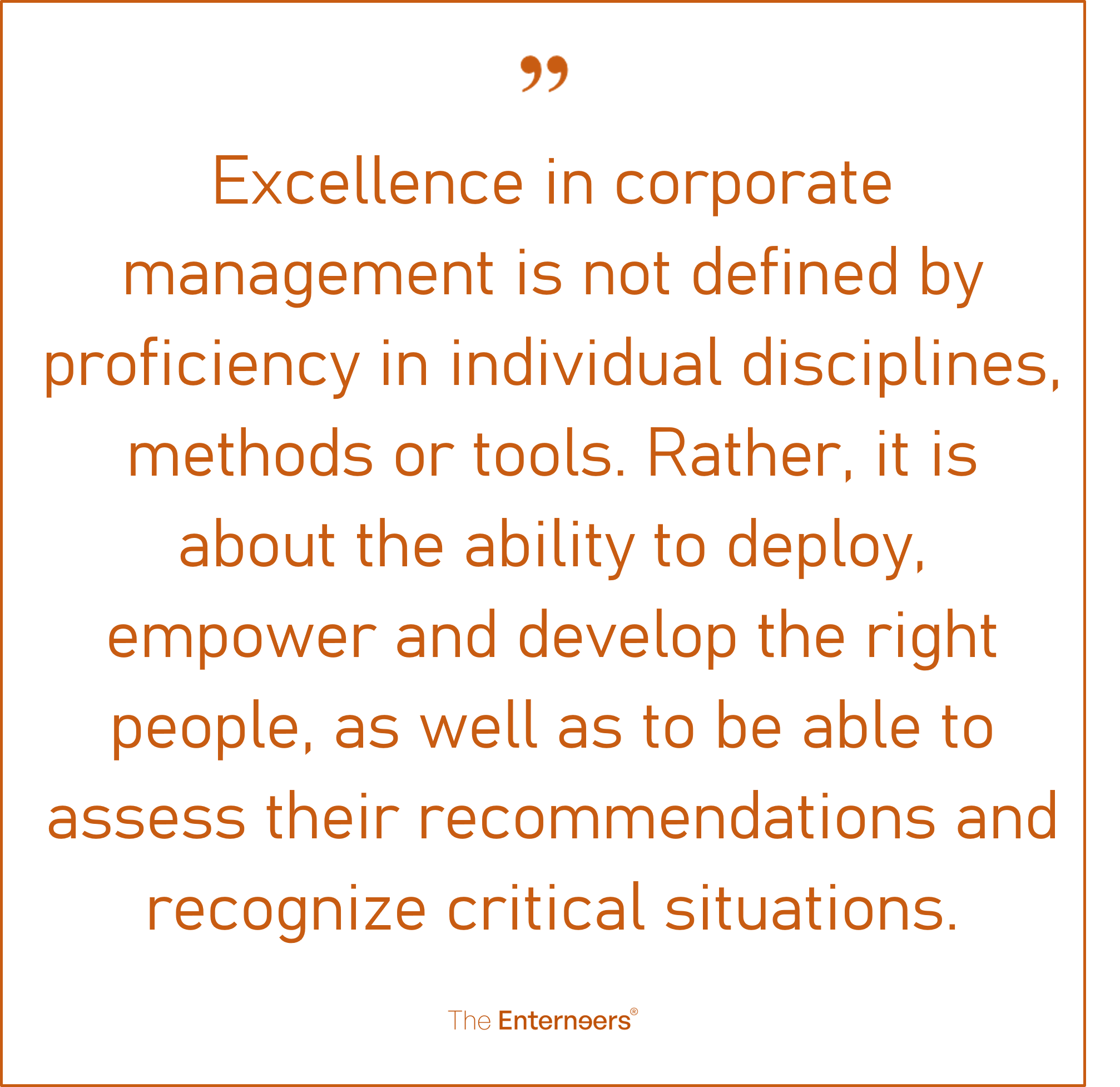
    It’s not necessary for entrepreneurs to master all the individual HR fields and their characteristics in detail, and, of course, they should not allow themselves to get bogged down with daily personnel tasks. Their own preferences or strengths should never be in the foreground when it comes to decisions about the direction of the department. But they need a good toolkit for controlling, applying, and developing their own way of thinking and behaving. And they need to be able to assign the right people to carry out the company’s HR tasks, as well as manage them and appropriately assess their recommendations or decision proposals.

    Finally, entrepreneurs need to know the difference between people management as a process within the operational organism and leadership as a managerial function. Those with this managerial function have an influence on how people management is implemented, but this is different from the tasks and methods of people management.

    The purpose of people management is to attract the best possible people to the company, to help them grow and develop within the company and to retain them. The aim is to enable the people who work in or with the company to optimally perform and collaborate, to motivate them and to help them maintain their health.

    quote07_en

    Important elements of people management are:

    Purpose

    Having a meaningful purpose is key to staying focused on the things that matter most. It helps in setting priorities and avoiding activities that don't serve the purpose. Employees will be most committed to their work when the company’s purpose is also meaningful to them and they feel as though they are contributing to the greater good.


    Involvement

    One key factor for success is the participation of staff in strategy and business activities as well as management and decision-making. It gives employees a sense of belonging to the company, which, in turn, leads them to become more reliable. They accept greater responsibility for their work and achieve better results.


    Stakeholder

    If a company does not know its stakeholders and understand their needs, it will not be able to actively manage business-relevant areas. This could include anyone with whom a company communicates or associates, such as customers, local community members, government officials, investors, competitors or anyone else who interacts with the company.


    Talent

    One important task of an entrepreneur is to create conditions that ensure that the right people with the appropriate skills are entrusted with tasks in which they can achieve the greatest possible success for both the company and themselves. This calls for awareness, intuition and consistency on the part of the entrepreneur.


    Career

    At first glance, the topic of career seems to be very personal for each individual employee. However, companies that consciously address the career planning and ongoing development of their employees can better develop talent and more effectively put it to use, helping to avoid undesirable employee turnover and demotivation.


    Recruitment

    Successful recruitment is the result of professional interaction between all individuals involved in the process. This is an important, sensitive and highly individualised process, so it is essential to have the necessary awareness and properly set priorities. Entrepreneurs must ensure that this interaction runs well.


    Alumni

    Corporate alumni can enhance employee loyalty, reduce employee turnover and retain talent by leveraging the power of a network of past and present employees. Past employees may become customers as well as deliver benefits in the form of new hires, referrals, marketers, lobbyists, investors, suppliers and many more.


    clickButtonEE_thumb
    More about People Management

    Working On versus In Your Business

    The professional experience shoes, many entrepreneurs are too involved in day-to-day operations of their business. This means that they don’t spend enough time trying to sustainable grow the business. Numerous professional articles speak of a trap when entrepreneurs fail to work more on their business rather than in it.
    Successful Enterneering® (=Enterprise Engineering) is all about working on the business.

    What’s the Difference Between Working IN & Working ON Your Business?

    Many entrepreneurs tend to work more in rather than on their company. Too much of their time is taken up by day-to-day responsibilities that should be delegated to someone else. As a result, they are left with limited time for sustainable business development, and without these much-needed top-level activities, the business is more likely to fail in its growth phases. Successful Enterneering® (=Enterprise Engineering) is all about working on the business.

    We explain what is behind it and how you can avoid falling into this trap in working on your business.

    To get a better impression about the difference between working IN & working ON your business see the table below for some examples of tasks that represent “working IN your business” and “working ON your business”.


    Who actually runs your business while you do the work of others?

    Do you still spend a lot of time working on concrete tasks, projects, customers, or contracts, we mean working ‘in’ the business? Or is your work predominantly ‘on’ the business, like on strategic partnerships, more complex structures, future corporate organisation and above all on the soft elements of people and culture?

    How to Work ON Your Business Effectively?


    Entrepreneurs who successfully implement this form of work on the company are practising active and not reactive enterprise engineering (=Enterneering®). Learn more about the successful implementation of Enterneering®