Keeping Growth from Becoming a Threat

Innumerable companies pursue a clear growth strategy and yet, according to business professor Larry E. Greiner, in most cases, all growth periods end in a leadership crisis. Using a sample case study as an illustration, this article will explain the reasons behind this as well as what every entrepreneur needs to know about themself to achieve maximum successful company growth.

I apologise to my readers for not choosing a more positive sample case study. I believe, however, that this example clearly and strongly conveys the significance and practical relevance of the topic. In addition, some of the dynamics described would not occur in an example where proactive corporate management worked to avoid or downplay certain developments, thus preventing them from being explained as they are within this context.

Many different publications address the different phases of corporate growth. Essentially, it is irrelevant how many steps you divide this cycle into. What is important is to recognise that each of these phases has its own characteristics. And since we humans are so similar in our basic genetic traits, there is obviously a strikingly large overlap of consistently similar entrepreneurial behavioural patterns. In addition, certain constraints arise almost naturally in the individual phases. The following article attempts to describe and exemplify these phases and some of the most common effects experienced. A sample case study will be used as an illustration, with no claim to completeness or scientific merit.

Start-Up

Dr E. is a PhD specialist in a highly complex technology sector. She has an innovative business idea. Dr E. is highly motivated and absolutely convinced that she can offer a consistently competitive product. Her concept is impressive; she obtains funding and is able to persuade two of her former fellow students to partner up with her – the founding members are in place. The team begins its start-up. Each of the three has memorised the business concept and is strongly committed to success. In this phase, this small team is the company’s primary mainstay and Dr E. is the most important team member. Together, they make up the development, sales, production, logistics, and administrative departments, all in one.

Starting off on this positive basis and equipped with a small but effective network of contacts, the business quickly gets off the ground. The small team takes a personal approach to winning over each of its customers, investing a great deal of time in this. With only a few minor setbacks, the business is soon up and running with its first orders, and it continues to steadily grow. During the start-up phase, the team works around the clock, and their high level of commitment ultimately also leads to market rewards as demand increases to a euphoria-inspiring level.

At the peak of this phase, the young company can point to resilient customer relationships and the abundant positive feedback it has already received from the market. They have delivered on the quality promised to customers in this phase and their personal business relationships have matured. Before progressing to the subsequent phases, it is typically still necessary for a start-up to ensure that the increasing financial needs will be able to be met.

The young team celebrates its successes, and its members spur each other on to ever more personal excellence. Sales increase for the first time, making it clear that additional staff will have to be hired. This was also factored into in the original business plan. But the need is now greater than anticipated and the most desirable candidates are looking for salaries that are not exactly within budget. The company makes some concessions with regard to their requirements and hires a few people at conditions that are still quite favourable overall. The new employees receive personalised training and are integrated into the small and still manageable team. Even now, every staff member is still familiar with nearly all of the company’s processes and procedures. Their own roles and importance as well as those of the others are transparent and well-understood. Motivation remains high and the team rejoices at every new assignment. Successes and failures are shared openly. Initial profits are rolling in and the business plan is working. Dr E. is justifiably quite proud and feels completely validated in her approach.

Maturity – Growth I

The start-up months after the founding of the company have flown by and according to its own assessment, the company is in the middle of the growth phase. So far, neither Dr E. nor her founding team has had to deal intensively or from a planning perspective with structural or organisational issues like the ones they have heard about or observed among some of their “older” client companies. Based on the existing framework, which has worked well so far, more staff are now being recruited. However, for the first time, they find themselves under pressure to fill positions, as the need for helping hands has increased significantly.

The increased number of employees leads to the first bump in the road for the operational flow. The communication channels become more complex and the information flows that have been working well up until now are repeatedly interrupted. Management staff intensifies their communications and introduces regular meetings and events that include all employees. None of the people working in the company has sufficient capacity to carry out classic leadership work. However, a decidedly informal and communicative collaborative style effectively compensates for this deficit. This always works especially well at the end of the week, when euphoria and inspiration are at a high. This has now resulted in an understandably increased level of self-confidence. Company management has become bolder, and much more trusting in its small organisation, now approaching the recruitment of new personnel with greater confidence. The organisation’s staffing needs have increased, so that now and then quantity and price have to take precedence over quality. In taking this approach, the company is either consciously or unconsciously accepting a reduction in job performance and corporate resilience. The difference between a merely adequately qualified helping hand and an experienced, well-qualified employee whose profile represents true enrichment for the company is neither sufficiently nor consistently taken into consideration at this point – after all, skills and knowledge can always somehow be “acquired”, and besides, there is the cost factor to take into account.

The moment has long since passed when the founding team was able to handle everything by themselves. The rest of the staff, however, possesses neither their experience nor their expertise. For the first time, the company is lacking overall know-how for important operations. The first defects and errors begin to appear, some of which make their way through to the customer. The continuous increase in the number of employees and the complexity of the processes requires new approaches to structures and management. As it turns out, the type of leadership now required is not necessarily Dr E.’s strong suit, and the other members of the founding team also have to come to grips with it.

For the founding team, the pressure to act dominates their dealings with clients as well as the daily coordination of projects and handling of disruptions. The team members react by deploying the same type of tactics they have used so far. During the turbulent and exciting early days of the company, the need for appropriate reporting that would reflect the most relevant key figures always took second place to dealing with important orders or processes. Among management staff, the dominant indicator of the company's performance was simply their gut feeling.

Growth II

Over the past few months, the number of customer orders has once again risen strongly. There are still new major sales successes to celebrate every week and there is currently no doubt about positive operating results. But the company's increasing size is weakening the accuracy of the gut feeling that previously worked so well but is now increasingly at odds with the real figures. No one is issuing any warnings about this at the moment, however, because the finance department has not invested in state-of-the-art financial monitoring, as their budget had to be diverted to fund an additional developer position. Even the founding team itself is not making any additional demands for high-quality reporting, because none of its members ever became closely acquainted with or, above all, learned to appreciate this tool in their previous positions. In addition, the finance team has been holding off on hiring an experienced management-level employee because the collaboration between the accounting department and the tax accountancy is working well and classic ERP system functionalities were also able to be effectively handled using cheaper on-board resources.

Growth management

Growth III – Overheating

Dr E.'s company continues to grow steadily in terms of sales and employee headcount. It no longer even resembles the start-up of the early years. Dr E. discovers that, for the first time, she no longer knows each of her new employees personally. Among the staff, groups of like-minded people have formed and interactions are not always as friendly as they previously were. Employees who have been there since the early days notice, for the first time, that the familial spirit of optimism has somehow faded. Discussions begin about the changes that have taken place and their visible effects, while growth-related structural and organisational challenges remain unfaced. Overwhelmingly, the solution demanded by the various teams to deal with the current challenges is the recruitment of additional staff.

Both the onboarding and induction of new staff is still quite situational and handled with a highly personal touch. However, it is not going as well as it did previously, as some employees have changed departments, the distribution of tasks has changed, and the first of the people who had been with the company from the beginning have left. The calls for better leadership and improved structures are now even louder. More and more often, the situation between employees and managers escalates. It is now becoming apparent even to third parties that some of the management positions have been filled by people who lack experience in leadership issues. Dr E.’s founding team has also not invested sufficient time to individual development in this area. Some team members have found that they don't really enjoy resolving these types of escalations, preferring to devote themselves to more tangible business challenges or interacting with customers.

Despite all of the internal friction, sales continue to grow. As a result, management staff is currently convinced that the stressful phenomena they are now experiencing are just the usual growing pains all successful companies go through. This also makes it seem clear that at least the current situation can be overcome by applying the same tactics as before. Some members of the management team are even overcome with exuberance, while, for the first time, company insiders express their feeling that management no longer has its feet firmly on the ground.

In the meantime, the finance department has hired two new accountants, but has not set up any financial monitoring system. There is no functioning or seriously taken early warning or risk management system in place, which means that the chance that specific cause-effect relationships will penetrate the consciousness of the company management is slim to none.

The first cancellations of customer orders are now coming in, but this is not yet leading to a drop in overall sales. Even the increasing error ratio, which more and more frequently directly affects customers, does not yet seem sufficiently alarming.

At the same time, management is delighted with the large increase in sales and the positive operating results. There is little to no discussion about the development of return and performance indicators, as there is still no meaningful KPI reporting. The fact that sales are constantly increasing leads the founding team to draw a fatal conclusion: the company is doing well on the market, otherwise customer orders would not be on the rise.

With this assessment, the management team continues to engage in the same type of tactics they have always pursued. Individual fires are courageously put out and growing workloads continue to be managed by hiring additional staff. Far-reaching structural and organisational measures involving major investments either fail to materialise or are cut back to an inappropriately low level.

Growth damages

Following a steady rise in sales from the founding days of the company, revenues have long since begun to stagnate. In some operational units, losses are increasing. Customers have noticed a downturn in company reliability and quality, and in surveys, customer satisfaction has dropped for the first time. The continuing boom in sales has meant that the company still maintains liquidity, but the current disruptions, coupled with the level of success desired by top management, have led to company leadership flip-flopping between a variety of ad hoc measures.

From here on out, the outcome of our sample case will depend in large part on management's awareness and ability to change. If Dr E. and her management team become detached from reality and their significant stakeholders, they are headed for a disaster.

In light of the course of events described above, the question arises as to whether Dr E. and her staff have the strength and skills required to initiate the necessary and painful changes and restructuring measures. And the question still remains as to how to finance these measures – as well as how to come up with the right story to tell investors, customers and creditors. If these measures fail, all signposts point to the final phase in the growth model described below.

Growth crash

In our case study, Dr E. fails to act on the enormous pressure from within the company to take necessary restructuring measures. Over the past few months, she has also fallen out with some members of the management team. Her determination and joy in building up the company have been diminished. In some business units, uncertainty and a lack of direction are on the rise. To avoid jeopardising the company's success, the shareholders have decided to find a suitable investor for the company.

. . .


In each of the growth phases described above, different tools and measures can be deployed so that the individual development stages can be negotiated successfully and unscathed. In our view, the most important basic prerequisites are an awareness of typical or predictable effects and situations as well as the acceptance that, in the absence of proactive measures, it will be impossible – or at least extraordinarily difficult – to avoid damages resulting from company growth. Only after these first two prerequisites have been met do the abilities of the people involved and the company as a whole follow as additional prerequisites.
About Entrepreneurship, Leadership and Management

Why is it so important for business leaders to be able to distinguish between the roles of entrepreneur, leader and manager? Successful entrepreneurs focus on vision and strategy; they guide their employees and remove obstacles from the path to success, much as an athletic coach does.

Why is it so important for business leaders to be able to distinguish between the roles of entrepreneur, leader and manager? The search for the correct answer likely has to do first and foremost with the deductions we make from observing our own thinking and actions. The larger and more complex the business and, thus the company itself becomes, the greater the extent to which staff and systems interact in different workflows, and the more that external stakeholders are involved, the more significant these deductions become. In practice, it can be observed that companies that grow successfully are usually managed by executives who consistently focus on their appropriate, sustainable role within the company.

Successful entrepreneurs focus on vision and strategy; they guide their employees and remove obstacles from the path to success, much as an athletic coach does. In contrast, managers typically focus more on the execution of tasks within the business. Leaders, on the other hand, deal with the staffing, equipping, empowerment, motivation and development of staff and business units. When managers also act like entrepreneurs, with a corresponding far-reaching scope of action and decision-making, they are also referred to as ‘intrapreneurs’. For the sake of simplicity, in what follows, no distinction is made between intrapreneur and entrepreneur.

Executive leadership involves providing a compelling vision and clear direction. Successful entrepreneurs clarify priorities and expectations, define employee roles and ensure that the structures and resources employees need to accomplish their tasks are in place.

The presence and authenticity with which entrepreneurs lead are crucial to employee job satisfaction. To engage today’s workforce, entrepreneurs must focus more on leading than managing. Many employees are seeking coaches who can help them develop their strengths and capitalise on them to provide added value for the company. This is especially true when it comes to the younger generation. Entrepreneurial success is also determined by the will and ability of the individual to carry out this role within the company.

Leading an effective company means gaining distance from the day-to-day business and focusing on a clear strategy and vision – the "whats" and "whys". The "hows” should be left to the management and the team. If you’re used to triaging problems, putting out fires and managing from a reactive standpoint, this can be challenging. But, as I’ve learned the hard way, the ability to proactively light the way is a learnable skill.


Managers Execute, Leaders Lead and
Entrepreneurs Inspire the Larger Picture


One fundamental aspect of leadership is directing people’s attention. To do so effectively, entrepreneurs first need to focus their own attention. Only once they have done this should they turn their focus to others, eventually concentrating on the big picture.

Self-awareness is the basis of emotional intelligence. Listening to our inner voice and paying close attention to internal physiological signals is critical. This also includes our gut feelings, the so-called “somatic markers” or sensations that tell us whether something feels right or wrong.

One decisive criterion is authenticity – being the same person to others as you are to yourself. This makes it important to pay attention to others’ views of you – especially those people whose opinions you value and whom you trust to give you honest feedback – and assess your own authentic impact.

Another decisive factor is cognitive control. This enables you to pursue your goals regardless of setbacks and distractions. Effective cognitive control is exhibited by entrepreneurs who can stay calm in a crisis, resist becoming agitated, and bounce back from disappointments and failures.

Empathy is an essential element for being able to successfully perceive other people. Entrepreneurs who can effectively focus on others are those whose opinions carry the most weight. They are able to find common ground and make people want to work with them.

We can distinguish three types of empathy that are important for effective leadership: cognitive empathy (understanding someone else’s perspective); emotional empathy (feeling what someone else feels); and empathic concern (sensing what someone else needs from you).

Finally, having an outward focus will help an entrepreneur become a good listener and a good questioner. Strategic thinking involves looking for ways to exploit your current advantages while exploring new ones.

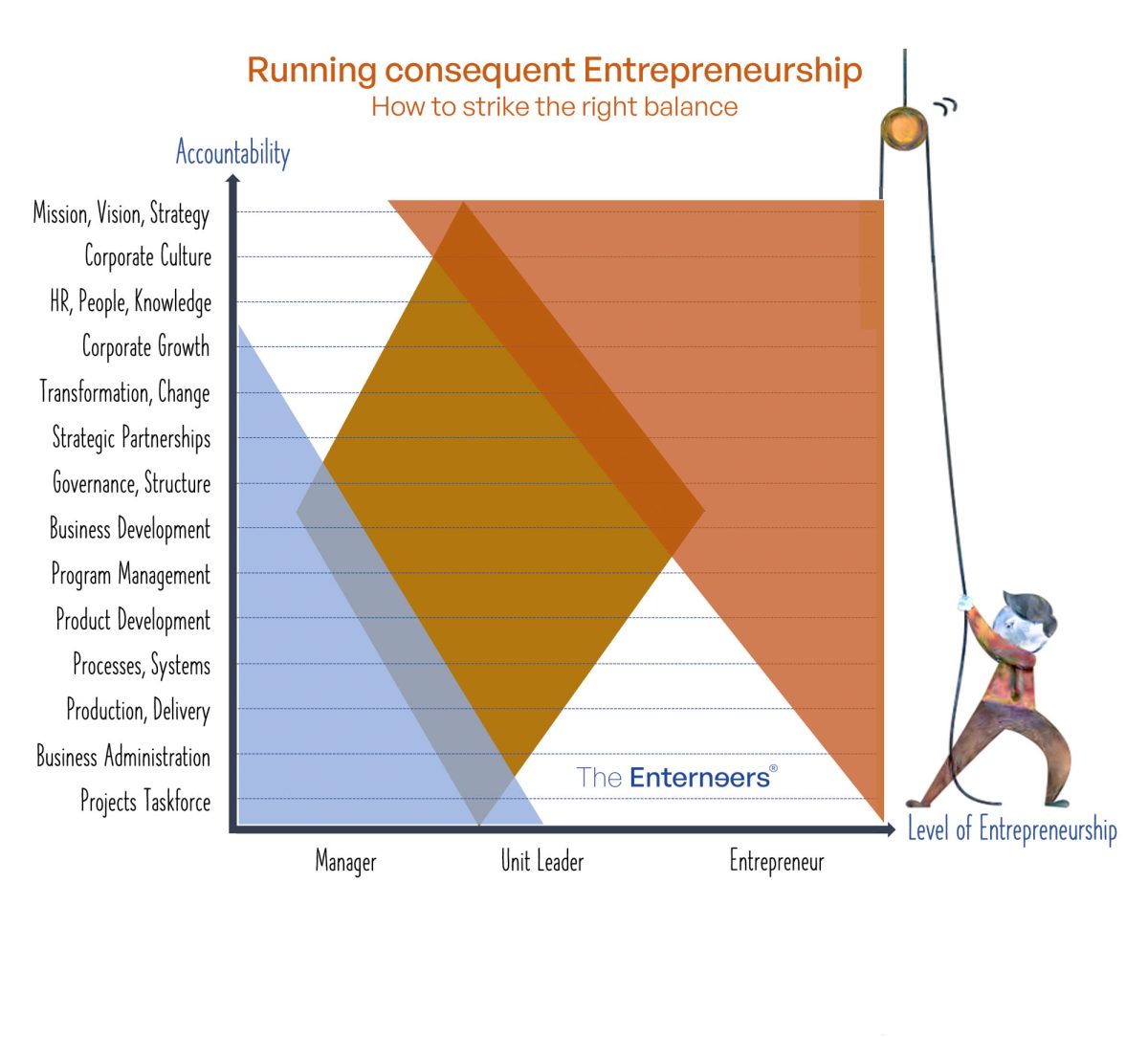
An often-mentioned challenge for entrepreneurs is the mastering and continual adjustment of the never-ending balancing act between operational constraints and the targeted tasks for the larger picture. It can be exhausting and energy-draining to constantly have to direct your attention to this "outer, upper corner" of the action matrix.

Simple things can often be helpful in becoming and remaining successful:

  • Establish core values and follow them. Many companies speak publicly about their core values, but these can be hollow words if the decision-makers at the top of the company are not authentically exemplifying these values and if they are not being operationalized in any way. The magic happens once core values are ingrained into employees’ daily work lives and are driving more autonomous decision-making.
  • Nurture your own professional development. Too often, entrepreneurs assume responsibility for everyone else on their teams except themselves. Although there are times when all of us need to manage, entrepreneurs are usually proactive; managers are reactive. To be an effective entrepreneur, proactively set aside time for your own professional development.
  • Delegate consistently and professionally, actively protecting yourself from burn-out. If you try to do everything yourself, you will inevitably see diminishing returns on the time you invest. Successful entrepreneurs spend most of their time on tasks that utilise their own unique skills and abilities and leave the rest to others who are more competent in those areas.
  • Beware of toxic people and structures. Actively cultivate a cooperative, people- and success-oriented corporate culture. Eliminate negative situations and possible sources of toxic developments as early as possible. Give appropriate priority and resources to active development of the corporate cultural.
  • Ensure that your company has an integrated and operationalised strategy and implement it. Make the meaning and purpose of the company as well as the value of every person who works there transparent.
  • Measure performance and success and regularly look to the "outer, upper corner" of the action matrix.

If you need support or training in some of the areas described above, don’t be afraid to admit this. Seek out appropriate support and multipliers from within your company. These tasks are simply too critical and momentous to be managed with less than complete success.

Working On versus In Your Business

The professional experience shoes, many entrepreneurs are too involved in day-to-day operations of their business. This means that they don’t spend enough time trying to sustainable grow the business. Numerous professional articles speak of a trap when entrepreneurs fail to work more on their business rather than in it.
Successful Enterneering® (=Enterprise Engineering) is all about working on the business.

What’s the Difference Between Working IN & Working ON Your Business?

Many entrepreneurs tend to work more in rather than on their company. Too much of their time is taken up by day-to-day responsibilities that should be delegated to someone else. As a result, they are left with limited time for sustainable business development, and without these much-needed top-level activities, the business is more likely to fail in its growth phases. Successful Enterneering® (=Enterprise Engineering) is all about working on the business.

We explain what is behind it and how you can avoid falling into this trap in working on your business.

To get a better impression about the difference between working IN & working ON your business see the table below for some examples of tasks that represent “working IN your business” and “working ON your business”.


Who actually runs your business while you do the work of others?

Do you still spend a lot of time working on concrete tasks, projects, customers, or contracts, we mean working ‘in’ the business? Or is your work predominantly ‘on’ the business, like on strategic partnerships, more complex structures, future corporate organisation and above all on the soft elements of people and culture?

How to Work ON Your Business Effectively?


Entrepreneurs who successfully implement this form of work on the company are practising active and not reactive enterprise engineering (=Enterneering®). Learn more about the successful implementation of Enterneering®

Who’s Actually Interested in New Work?

The understanding of work in times of globalisation and digitalisation is closely linked to values like independence, freedom, creativity, personal development and self-organisation. Working people long for jobs that fit in well with their private lives, preferences, and free time; they expect the same flexibility from their employers in the structuring of the work environment as their companies expect from them in terms of work management.

Many years of entrepreneurial practice show that companies will only implement new work environments if they are convinced of the benefits of the change. Exceptions to this are entrepreneurs who develop corporate work environments based on their own personal motivations and value systems.

The understanding of work in times of globalisation and digitalisation is closely linked to values like independence, freedom, creativity, personal development and self-organisation. Working people long for jobs that fit in well with their private lives, preferences, and free time; they expect the same flexibility from their employers in the structuring of the work environment as their companies expect from them in terms of work management.

Then, of course, the pandemic arrived, bringing about a turbo change in the working world. And then came the end of the pandemic, and somehow everything is once again different and yet not the same as before.

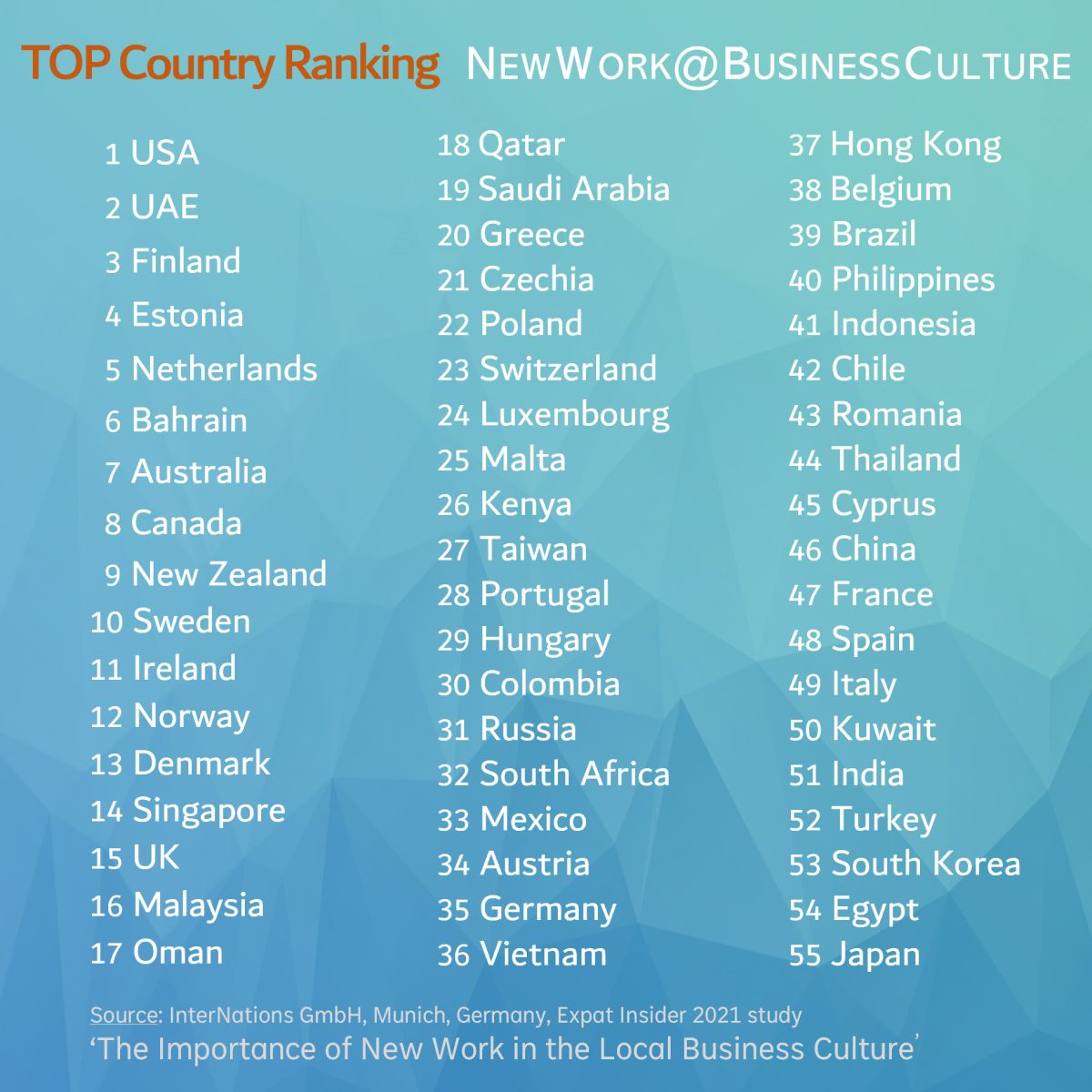
According to a 2021 study by internations.org, the top five countries in which the importance of New Work was rated highest by expats worldwide were the USA, the United Arab Emirates (UAE), Finland, Estonia and the Netherlands. Apart from the USA, the other four nations, the UAE, for instance, were viewed with astonishment. Nations like Germany, China, South Korea or Japan, considered leaders in other comparisons, are in the lower midfield or at the bottom of the ranking. Why is that? One relevant reason may be a lack of ability for change or the speed at which this is carried out. Another is most likely the result of corporate cultures and leadership styles that have been cultivated for decades. Entrepreneurs who are not willing or able to adapt or change their corporate culture will find it extremely difficult, if not impossible, to sustainably implement new work environments. Because one thing is certain: without a new culture, there is no “new work”!

Many years of entrepreneurial practice show that companies will only implement new work environments if they are convinced of the benefits of the change. Exceptions to this are entrepreneurs who develop corporate work environments based on their own personal motivations and value systems.

Find out whether New Work is right for your company, what you would need to do to implement it and what benefits it offers your company. In our Enterneering® blog, we explain the individual elements of corporate culture and people management and how companies can be organised in a way that is sustainable.

clickButtonEE_thumb
More about Enterneering®

The Impact of Corporate Purpose on Competitiveness

The importance of a strong corporate purpose is still underestimated in many companies. In markets with a high degree of industrialisation and technology, however, it is probably one of the most important components of strategic corporate development. Why is this such a big challenge? The answer lies in our past. For decades, economies of scale, rationalisation and increased efficiency have characterised the economic worlds of work. In these working worlds, a strong corporate purpose is not so crucial. But the digital transformation, pandemic-related resource and supply disruptions, climate change and demographic trends are bringing about enormous changes and fostering a new understanding of people for their environment, for their purchasing decisions and for their demands regarding work and leisure. Serious consideration of the corporate purpose requires foresight and patience. Entrepreneurs who invest their time and attention in this not only secure their competitive advantage, but also protect their company from the risk of vanishing into purposelessness.

In traditional business administration education, it has been and still is generally taught that the primary purpose of a company centres on quantitative principles, such as profit maximisation or maximisation of shareholder value. Innumerable companies and large corporations still strongly gear their culture, leadership and organisation towards this. The world in which we live and work today is undergoing massive changes in terms of digitalisation, climate change and resource shortages. In addition, younger generations have a different, more open and demanding understanding of the living and working spaces in which they must or want to fulfil themselves. The more advanced, industrialised and prosperous a society is today, the greater the proportion of the population that is concerned not only with mere subsistence, but is also reflective on the purpose of work and life and has a desire to contribute to a greater cause.

People who are self-motivated, who possess what is known as intrinsic motivation, who consciously and actively contribute to their work environments and want to identify with these, need significantly more than sales targets, profit goals or share prices to feel a sense of connection. On the contrary, an increasing percentage of employees view these guiding principles as rather ordinary or quite generalised and emotionally unappealing. This is especially true in locations where, due to demographic and economic developments, the demand for well-qualified workers exceeds the supply. It is precisely at this point that companies without a well-defined, authentically practiced corporate purpose rapidly find themselves at a competitive disadvantage. As they follow their career paths, well-qualified candidates looking for meaningful jobs in service of a greater cause seek out employers who embody an analogous purpose. And it is precisely these people who are also likely to emerge on the market as customers with similar requirements.

And there is another important argument. Companies that fail to establish the authentic, visibly practiced purpose currently being called for and instead focus on traditional one-dimensional targets, such as turnover, earnings or returns, will, sooner or later, have a high percentage of employees who can and want to live with precisely this situation in the longer term. This probably includes people for whom their income or regular working hours or having limited personal responsibility at the best possible salary and benefits are more important than innovative thinking and action, independent and solution-oriented work and the assumption of personal responsibility in dynamic and change-rich jobs. Entrepreneurs must judge for themselves the types of people they want or need to employ – where and how and in what proportion – to achieve their strategic goals.

Entrepreneurs themselves should and must deal individually with the question of how relevant their own corporate purpose is to the success they desire. There is no right or wrong or better or worse decision. It is and remains an individual consideration and decision. This has much to do with the top leadership of the company and the corporate goals, because a corporate purpose can only be a sustainably positive element if it is authentic.

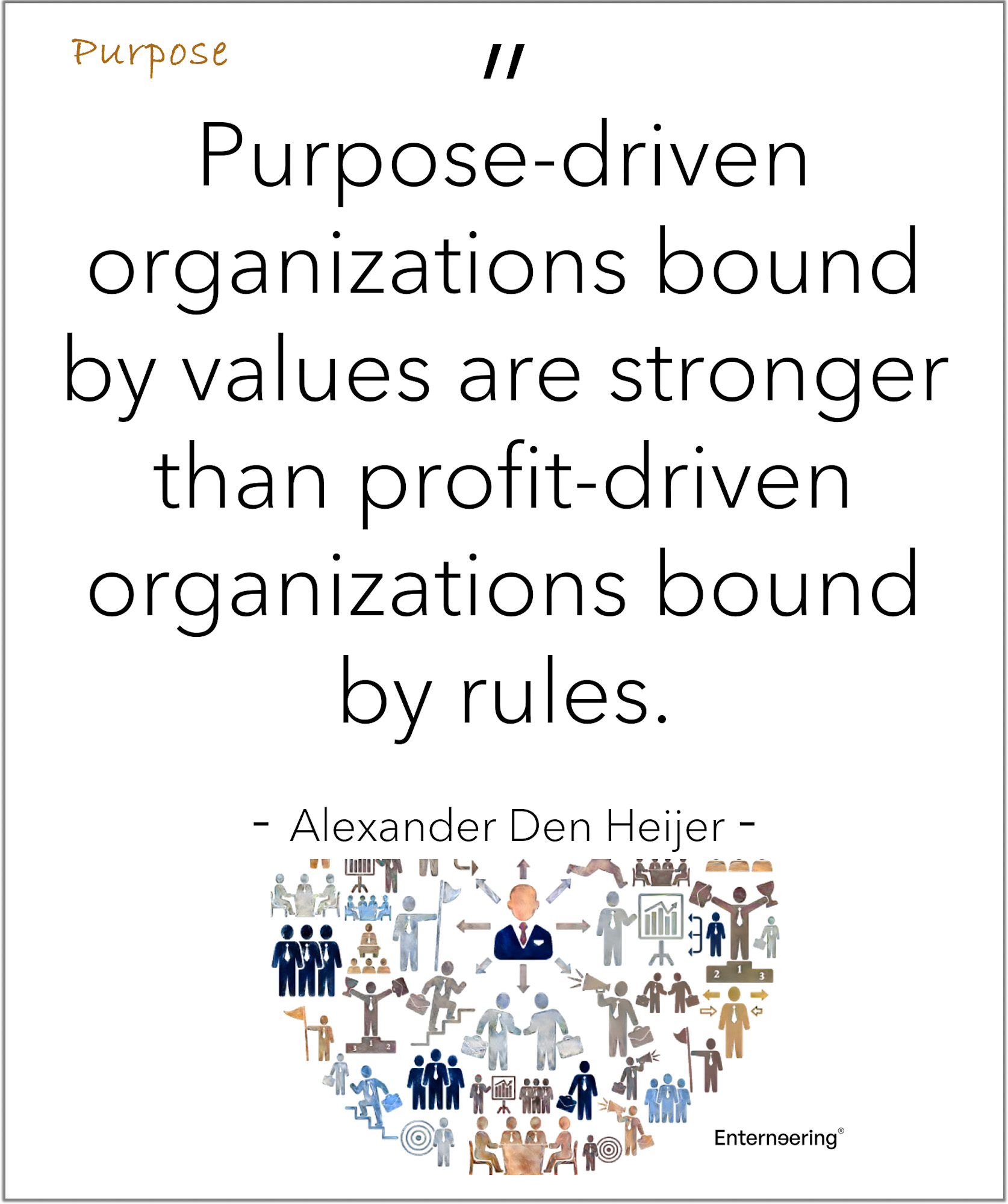
purpose_qoute_heijer_edited
Signs of the need for action

If one or more of the following situations apply to your company, this may indicate deficits in the implementation of the corporate purpose:

  • The number of employees who actively and repeatedly ask about the actual purpose of their work or specific projects, or who discuss this with each other, is notable or has increased.
  • In meetings, surveys or conferences, employees increasingly ask about the actual purpose of the company.
  • In the context of strategic development, managers emphatically or persistently question the meaning and purpose behind the financial figures.
  • There is an increase in occasions where well-qualified applicants more intensively question the purpose of the company in job interviews.
  • Candidates more frequently turn down job offers, saying that they are accepting a different job offer because they can offer more or make a greater personal contribution.
  • In the primary published corporate strategy documents, no explanation is provided regarding the purpose of the company's existence.
  • External parties (partners, advisors, friends, family) do not fully grasp the meaning and purpose of the company.

As with most issues in Enterneering, the issue of corporate purpose cannot be viewed in isolation from the other elements of the enterprise. It may require targeted questioning, careful listening and self-reflective action on the part of management to identify and define areas where action is needed. And a corporate purpose alone is not a cure-all. The first steps are awareness of the issue and a willingness to seriously and consistently address existing deficits.

Definition Purpose

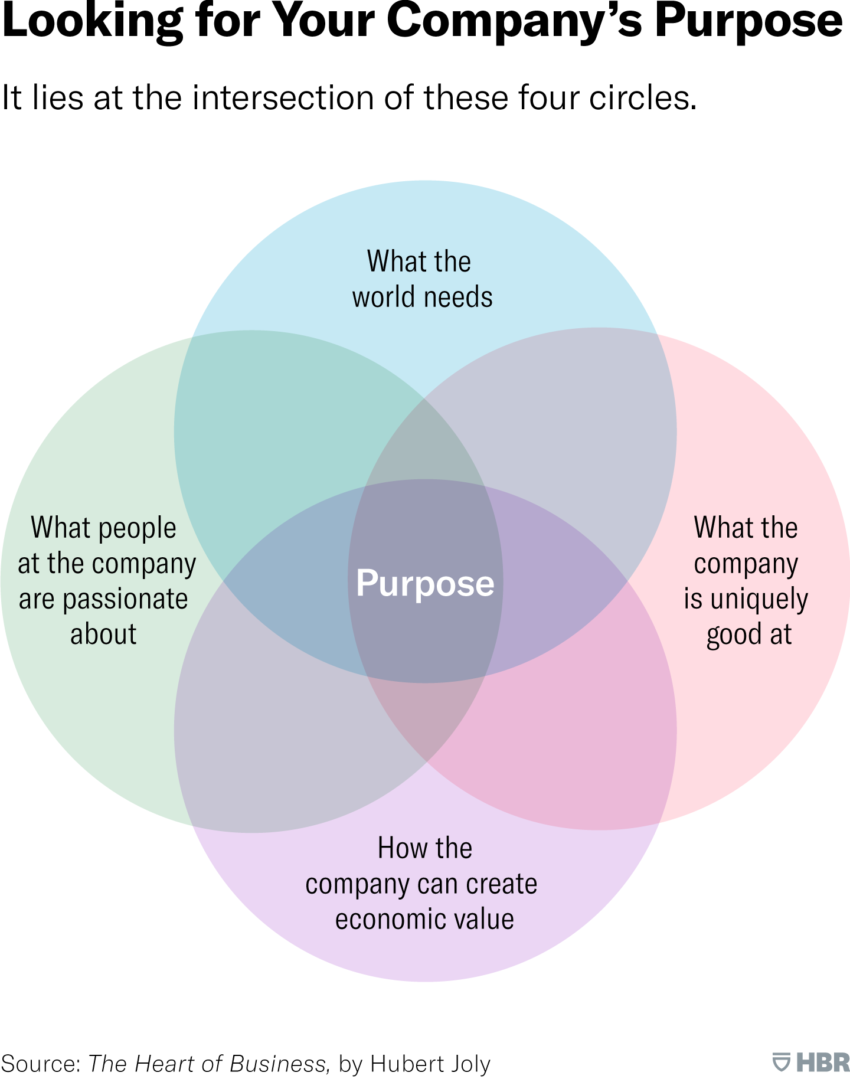
This refers to the meaning and purpose of a company beyond its monetary goals. While in traditional business management, financial success is understood to be the primary purpose of a company, the definition of purpose in terms of human-oriented corporate management goes far beyond economic success. It describes the company’s raison d'être in a social, partially even global, context. In this modern understanding of a company, economic or financial success is a basic prerequisite for the successful management of a company, which is rounded out with the definition of the company’s intangible purpose. In other words, financial success is like the air we breathe, while purpose is the emotional component of heart and soul. It is precisely this emotional component that is essential in organisations where there is a high degree of self-organisation, agility and new work. Companies with a sustainably integrated corporate purpose see themselves not only as profit-seeking market participants but as members of society, with their own responsibilities. They no longer differentiate businesses from public or state institutions according to conventional patterns but see themselves as part of the entire social system. This makes it clear that as companies, they, too, bear responsibility for such issues as the environment, climate, health or public infrastructure. In an article published in 2021 in the Harvard Business Review, entitled "Creating a Meaningful Corporate Purpose", the veteran US business expert and author Hubert Joly defines four overlapping fields that determine corporate purpose.

W211019_JOLY_COMPANY_PURPOSE_360-850x1079

Corporate purpose differs from the corporate vision and mission. The vision describes an aspirational, possibly also idealised image of the future while the mission describes the self-image of the company in the present. Both are predominantly oriented towards the company. The corporate purpose goes beyond the boundaries of the company and reaches into the social spheres of life. It answers the question of why the company is needed in the first place and what difference it makes to the outside world. Many companies have a vision and a mission, but not a purpose. Some companies have such a strong purpose that they can successfully do without a vision or mission.


Arguments for a strong corporate purpose

People Management and Leadership
Companies without a strong or firmly anchored corporate purpose have to rely instead on individual people to assess and decide what is right and wrong or desired and undesired. This approach centres around the egos, personal experiences and interests of individuals. This is a suitable approach in tightly hierarchical or autocratic structures and works in the longer term. However, it does not work in structures where a high degree of personal responsibility, self-organisation and agility is desired and where thinking and acting in functional boxes (silo thinking) is to be avoided. Here, having a strong corporate purpose helps to minimise individual interests and allow the overall goal or greater good to be pursued. Within larger organisations, it also prevents individual departments from defining their own mission statements and the development of subcultures. Modern leadership in self-organised and dynamic structures needs a strong corporate purpose to create a powerful and motivated organisation.

Recruitment and Talent
Companies looking to hire and retain well-qualified candidates are increasingly confronted with the need to offer more than just a nicely equipped workplace, a good working atmosphere, social benefits and adequate pay. More and more, people also value jobs with which they can personally identify and where they can make a tangible contribution. Companies with a strong corporate purpose can provide an important point of connection for their employees. Employee motivation and loyalty both increase where there is a connection to the meaning and purpose of the company or the job and where people believe that they are serving a greater, higher cause. This is not only an advantage when it comes to recruiting and retaining staff, but also in maintaining or increasing employees’ willingness to perform – even without having to constantly discuss financial incentives.

Marketing and Sales
A strong corporate purpose with significant external impact is a core element of smart marketing. It benefits companies who do not want their sales success to be achieved through traditional transaction-related ‘pushing’ but want to ‘attract’ customers through self-motivation on the basis of authentic and modern marketing. In an increasing number of markets, customers want to identify with the purpose of the salesperson. They want to be able to assess the meaning and purpose the provider of their goods and services fulfils. More and more, customers want to feel good about their purchases. Factors such as sustainability, climate protection, health and resource conservation are becoming increasingly important.

Agility and Focusing
A key feature of agile work is the ability of a company to implement the principle of self-organisation. Without a strong corporate purpose, self-organised working methods cannot be efficiently implemented. Successful self-organisation does not mean complete autonomy and uncontrolled decentralised decision-making. It requires a clear common direction and overarching guardrails. A jointly pursued, firmly anchored corporate purpose serves as the central point of orientation for all the company’s employees.

Transformation and Change
For successful company transformation or change processes, it is crucial to enable the identification and orientation of the people involved in the process. This ensures that measures can be carried out in a focused and well-thought-out manner. The increased dynamics and complexity in such processes can easily lead to high levels of uncertainty. A strong corporate purpose provides an important point of orientation and acts as a stabilising factor. It assists in maintaining an internal connection between the individual areas of the company and the people who work there.


3 Steps to developing a corporate purpose

1. Reflection and Deliberation
Everything begins with honest self-reflection. Two questions are essential:

  • Is there any recognition at all that the implementation or further development of the corporate purpose has a high strategic value for the company?
  • Is the company’s top management willing and able to authentically implement a strong corporate purpose?

Both questions point in the same direction. Only those who clearly recognise the importance of purpose for themselves and their company and who seriously want to develop or introduce this element should set out on this path. Those who favour authoritarian leadership structures or rely heavily on micromanagement in their businesses should carefully weigh the effort required to implement a strong corporate purpose. Ultimately, success depends decisively on the ability of the company's top management to authentically exemplify the corporate purpose and to take it into account in its everyday business deliberations and decisions.

Note to entrepreneurs and intrapreneurs on the practical application of this: A weak corporate purpose can have a more negative impact than having no defined purpose at all. Many people take such core elements of the company very seriously and are even more disappointed if the purpose is not meant seriously or is not reflected in current business activities. This can result in a company losing not only employees but also customers.

If the decision is made to implement or further develop the corporate purpose, there should be no reason not to get started. As a rule, the process of deliberation is characterised by dialogue at the management level. These discussions are particularly fruitful if they are led and moderated by company owners and top management.

2. Structuring and Distribution
Developing a strong corporate purpose will entail several structured passes or loops. To ensure good progress between these individual loops, it helps to define a simple but consistent structure, a “process model”. The following is an example of a possible process model. The approach chosen here is characterised by joint collaboration of a group of people (e.g. top management or mixed staff profiles). The group’s work begins with the “golden circle”. The participants classify their statements about the purpose of the company in three concentric circles, from the outside to the inside, with WHAT, HOW and WHY. According to the "5-Why" approach, the classification of the statements on the WHY is only done after questioning the WHY five times. This ensures that the core of the WHY is really penetrated.

In the search for purpose, it is sometimes difficult to put a concrete statement into words. A tool from the agile working world can help here – the use of images. Images are known to be a key to our subconscious. It can therefore help to provide the participants with pictures or postcards and have them relate what associations these may have with the company's purpose.

Finally, the options derived from this process should be placed in the context of the most essential corporate pillars and assessed for compatibility. The most critical corporate pillars usually include the strategy, the people within the company, including their habits and behaviours, the capabilities of the company, the corporate culture being practiced and any relevant external conditions. The simplest methodology for doing this is to assign points or grades for each option and company pillar.

Note to entrepreneurs and intrapreneurs on the practical application of this: The method or process model used is not of great importance. Much more important is the dialogue between the participants and the interaction that accompanies this. In most cases, a common group perspective quickly emerges, and even where there are different points of view, the chosen structure provides sufficient orientation and opportunity for joint evaluation.

3. Implementation and Authenticity
Since the entire topic of corporate purpose revolves around people, inclinations and emotions, the success of a strong purpose depends upon having it visibly and authentically anchored internally within the people who work for the company and, ideally, also externally. The corporate purpose must be embedded in the corporate strategy in such a way that there is compatibility and no contradictions arise. The purpose must be made tangible. This means that employees, customers and business partners should not only understand the corporate purpose, but also be able to see that the company is really serving the purpose.

Note to entrepreneurs and intrapreneurs on the practical application of this: Because our environments, markets, customers and employees continually evolve and change, the corporate purpose cannot remain static. It should be anchored in such a way that it remains a topic of conversation among staff. Once the purpose is defined, the first step should, therefore, not necessarily be the creation of an image video or an advertising campaign. It is much more important to create the conditions that will allow employees to internalise the purpose and identify with it. It should become something they discuss amongst themselves and remind each other of. And they should be able to see that corporate management has also internalised this purpose and acts accordingly. Companies that succeed in doing this will have a strong corporate purpose, one that will inevitably spread beyond the boundaries of the company and produce a positive effect.


Conclusion

The importance of a strong corporate purpose is still underestimated in many companies. In markets with a high degree of industrialisation and technology, however, it is probably one of the most important components of strategic corporate development. Why is this such a big challenge? The answer lies in our past. For decades, economies of scale, rationalisation and increased efficiency have characterised the economic worlds of work. In these working worlds, a strong corporate purpose is not so crucial. But the digital transformation, pandemic-related resource and supply disruptions, climate change and demographic trends are bringing about enormous changes and fostering a new understanding of people for their environment, for their purchasing decisions and for their demands regarding work and leisure. Serious consideration of the corporate purpose requires foresight and patience. Entrepreneurs who invest their time and attention in this not only secure their competitive advantage, but also protect their company from the risk of vanishing into purposelessness.

clickButtonEE_thumb
More about People Management

50 years Growth Model by Greiner

Then as now: Success factors in growth. It’s fantastic that some principles are so constant. This enables us to better understand, comprehend and consciously adjust to them. You should definitely do the same.

Evolution and Revolution as Organizations Grow
by Larry E. Greiner, Harvard Business Review 7/8 1972

Then as now: Success factors in growth.

It's fantastic that some principles are so constant. This enables us to better understand, comprehend and consciously adjust to them. You should definitely do the same.

According to the Growth Model of the renowned business professor Larry E. Greiner, growing organisations go through certain development phases, all of which end in a leadership crisis.

Successful companies manage to influence the different phases in such a way that serious crises can be avoided. From my own experience I know both the successful and the other cases. Of course, in my 20 years as a manager I have gone through my own learning curve, made mistakes and experienced cause-and-effect principles in practice. I am firmly convinced that this essential component of entrepreneurship can combine motivation, fun and success if you engage in it early and consciously.

In our post Keeping Growth from Becoming a Threat, the individual phases and their cause-and-effect principles are explained concisely using a thoroughly representative practical example.

Learn more about