Keeping Growth from Becoming a Threat

Innumerable companies pursue a clear growth strategy and yet, according to business professor Larry E. Greiner, in most cases, all growth periods end in a leadership crisis. Using a sample case study as an illustration, this article will explain the reasons behind this as well as what every entrepreneur needs to know about themself to achieve maximum successful company growth.

I apologise to my readers for not choosing a more positive sample case study. I believe, however, that this example clearly and strongly conveys the significance and practical relevance of the topic. In addition, some of the dynamics described would not occur in an example where proactive corporate management worked to avoid or downplay certain developments, thus preventing them from being explained as they are within this context.

Many different publications address the different phases of corporate growth. Essentially, it is irrelevant how many steps you divide this cycle into. What is important is to recognise that each of these phases has its own characteristics. And since we humans are so similar in our basic genetic traits, there is obviously a strikingly large overlap of consistently similar entrepreneurial behavioural patterns. In addition, certain constraints arise almost naturally in the individual phases. The following article attempts to describe and exemplify these phases and some of the most common effects experienced. A sample case study will be used as an illustration, with no claim to completeness or scientific merit.

Start-Up

Dr E. is a PhD specialist in a highly complex technology sector. She has an innovative business idea. Dr E. is highly motivated and absolutely convinced that she can offer a consistently competitive product. Her concept is impressive; she obtains funding and is able to persuade two of her former fellow students to partner up with her – the founding members are in place. The team begins its start-up. Each of the three has memorised the business concept and is strongly committed to success. In this phase, this small team is the company’s primary mainstay and Dr E. is the most important team member. Together, they make up the development, sales, production, logistics, and administrative departments, all in one.

Starting off on this positive basis and equipped with a small but effective network of contacts, the business quickly gets off the ground. The small team takes a personal approach to winning over each of its customers, investing a great deal of time in this. With only a few minor setbacks, the business is soon up and running with its first orders, and it continues to steadily grow. During the start-up phase, the team works around the clock, and their high level of commitment ultimately also leads to market rewards as demand increases to a euphoria-inspiring level.

At the peak of this phase, the young company can point to resilient customer relationships and the abundant positive feedback it has already received from the market. They have delivered on the quality promised to customers in this phase and their personal business relationships have matured. Before progressing to the subsequent phases, it is typically still necessary for a start-up to ensure that the increasing financial needs will be able to be met.

The young team celebrates its successes, and its members spur each other on to ever more personal excellence. Sales increase for the first time, making it clear that additional staff will have to be hired. This was also factored into in the original business plan. But the need is now greater than anticipated and the most desirable candidates are looking for salaries that are not exactly within budget. The company makes some concessions with regard to their requirements and hires a few people at conditions that are still quite favourable overall. The new employees receive personalised training and are integrated into the small and still manageable team. Even now, every staff member is still familiar with nearly all of the company’s processes and procedures. Their own roles and importance as well as those of the others are transparent and well-understood. Motivation remains high and the team rejoices at every new assignment. Successes and failures are shared openly. Initial profits are rolling in and the business plan is working. Dr E. is justifiably quite proud and feels completely validated in her approach.

Maturity – Growth I

The start-up months after the founding of the company have flown by and according to its own assessment, the company is in the middle of the growth phase. So far, neither Dr E. nor her founding team has had to deal intensively or from a planning perspective with structural or organisational issues like the ones they have heard about or observed among some of their “older” client companies. Based on the existing framework, which has worked well so far, more staff are now being recruited. However, for the first time, they find themselves under pressure to fill positions, as the need for helping hands has increased significantly.

The increased number of employees leads to the first bump in the road for the operational flow. The communication channels become more complex and the information flows that have been working well up until now are repeatedly interrupted. Management staff intensifies their communications and introduces regular meetings and events that include all employees. None of the people working in the company has sufficient capacity to carry out classic leadership work. However, a decidedly informal and communicative collaborative style effectively compensates for this deficit. This always works especially well at the end of the week, when euphoria and inspiration are at a high. This has now resulted in an understandably increased level of self-confidence. Company management has become bolder, and much more trusting in its small organisation, now approaching the recruitment of new personnel with greater confidence. The organisation’s staffing needs have increased, so that now and then quantity and price have to take precedence over quality. In taking this approach, the company is either consciously or unconsciously accepting a reduction in job performance and corporate resilience. The difference between a merely adequately qualified helping hand and an experienced, well-qualified employee whose profile represents true enrichment for the company is neither sufficiently nor consistently taken into consideration at this point – after all, skills and knowledge can always somehow be “acquired”, and besides, there is the cost factor to take into account.

The moment has long since passed when the founding team was able to handle everything by themselves. The rest of the staff, however, possesses neither their experience nor their expertise. For the first time, the company is lacking overall know-how for important operations. The first defects and errors begin to appear, some of which make their way through to the customer. The continuous increase in the number of employees and the complexity of the processes requires new approaches to structures and management. As it turns out, the type of leadership now required is not necessarily Dr E.’s strong suit, and the other members of the founding team also have to come to grips with it.

For the founding team, the pressure to act dominates their dealings with clients as well as the daily coordination of projects and handling of disruptions. The team members react by deploying the same type of tactics they have used so far. During the turbulent and exciting early days of the company, the need for appropriate reporting that would reflect the most relevant key figures always took second place to dealing with important orders or processes. Among management staff, the dominant indicator of the company's performance was simply their gut feeling.

Growth II

Over the past few months, the number of customer orders has once again risen strongly. There are still new major sales successes to celebrate every week and there is currently no doubt about positive operating results. But the company's increasing size is weakening the accuracy of the gut feeling that previously worked so well but is now increasingly at odds with the real figures. No one is issuing any warnings about this at the moment, however, because the finance department has not invested in state-of-the-art financial monitoring, as their budget had to be diverted to fund an additional developer position. Even the founding team itself is not making any additional demands for high-quality reporting, because none of its members ever became closely acquainted with or, above all, learned to appreciate this tool in their previous positions. In addition, the finance team has been holding off on hiring an experienced management-level employee because the collaboration between the accounting department and the tax accountancy is working well and classic ERP system functionalities were also able to be effectively handled using cheaper on-board resources.

Growth management

Growth III – Overheating

Dr E.'s company continues to grow steadily in terms of sales and employee headcount. It no longer even resembles the start-up of the early years. Dr E. discovers that, for the first time, she no longer knows each of her new employees personally. Among the staff, groups of like-minded people have formed and interactions are not always as friendly as they previously were. Employees who have been there since the early days notice, for the first time, that the familial spirit of optimism has somehow faded. Discussions begin about the changes that have taken place and their visible effects, while growth-related structural and organisational challenges remain unfaced. Overwhelmingly, the solution demanded by the various teams to deal with the current challenges is the recruitment of additional staff.

Both the onboarding and induction of new staff is still quite situational and handled with a highly personal touch. However, it is not going as well as it did previously, as some employees have changed departments, the distribution of tasks has changed, and the first of the people who had been with the company from the beginning have left. The calls for better leadership and improved structures are now even louder. More and more often, the situation between employees and managers escalates. It is now becoming apparent even to third parties that some of the management positions have been filled by people who lack experience in leadership issues. Dr E.’s founding team has also not invested sufficient time to individual development in this area. Some team members have found that they don't really enjoy resolving these types of escalations, preferring to devote themselves to more tangible business challenges or interacting with customers.

Despite all of the internal friction, sales continue to grow. As a result, management staff is currently convinced that the stressful phenomena they are now experiencing are just the usual growing pains all successful companies go through. This also makes it seem clear that at least the current situation can be overcome by applying the same tactics as before. Some members of the management team are even overcome with exuberance, while, for the first time, company insiders express their feeling that management no longer has its feet firmly on the ground.

In the meantime, the finance department has hired two new accountants, but has not set up any financial monitoring system. There is no functioning or seriously taken early warning or risk management system in place, which means that the chance that specific cause-effect relationships will penetrate the consciousness of the company management is slim to none.

The first cancellations of customer orders are now coming in, but this is not yet leading to a drop in overall sales. Even the increasing error ratio, which more and more frequently directly affects customers, does not yet seem sufficiently alarming.

At the same time, management is delighted with the large increase in sales and the positive operating results. There is little to no discussion about the development of return and performance indicators, as there is still no meaningful KPI reporting. The fact that sales are constantly increasing leads the founding team to draw a fatal conclusion: the company is doing well on the market, otherwise customer orders would not be on the rise.

With this assessment, the management team continues to engage in the same type of tactics they have always pursued. Individual fires are courageously put out and growing workloads continue to be managed by hiring additional staff. Far-reaching structural and organisational measures involving major investments either fail to materialise or are cut back to an inappropriately low level.

Growth damages

Following a steady rise in sales from the founding days of the company, revenues have long since begun to stagnate. In some operational units, losses are increasing. Customers have noticed a downturn in company reliability and quality, and in surveys, customer satisfaction has dropped for the first time. The continuing boom in sales has meant that the company still maintains liquidity, but the current disruptions, coupled with the level of success desired by top management, have led to company leadership flip-flopping between a variety of ad hoc measures.

From here on out, the outcome of our sample case will depend in large part on management's awareness and ability to change. If Dr E. and her management team become detached from reality and their significant stakeholders, they are headed for a disaster.

In light of the course of events described above, the question arises as to whether Dr E. and her staff have the strength and skills required to initiate the necessary and painful changes and restructuring measures. And the question still remains as to how to finance these measures – as well as how to come up with the right story to tell investors, customers and creditors. If these measures fail, all signposts point to the final phase in the growth model described below.

Growth crash

In our case study, Dr E. fails to act on the enormous pressure from within the company to take necessary restructuring measures. Over the past few months, she has also fallen out with some members of the management team. Her determination and joy in building up the company have been diminished. In some business units, uncertainty and a lack of direction are on the rise. To avoid jeopardising the company's success, the shareholders have decided to find a suitable investor for the company.

. . .


In each of the growth phases described above, different tools and measures can be deployed so that the individual development stages can be negotiated successfully and unscathed. In our view, the most important basic prerequisites are an awareness of typical or predictable effects and situations as well as the acceptance that, in the absence of proactive measures, it will be impossible – or at least extraordinarily difficult – to avoid damages resulting from company growth. Only after these first two prerequisites have been met do the abilities of the people involved and the company as a whole follow as additional prerequisites.

Wie ein Unternehmen organisiert wird

Neben der Implementierung und der Weiterentwicklung der Kultur und der Menschen im Unternehmen zählt die Organisation des Unternehmens zu den Hauptaufgaben der Unternehmensleitung. Hier ist wichtig zu verstehen, dass es genau nicht um die Organisation einzelner Bereiche, Projekte, Prozesse oder Kundenbeziehungen geht, sondern um die Funktionsweise des Unternehmens sozusagen als Organismus.

Neben der Implementierung und der Weiterentwicklung der Kultur und der Menschen im Unternehmen zählt die Organisation des Unternehmens zu den Hauptaufgaben der Unternehmensleitung. Hier ist wichtig zu verstehen, dass es genau nicht um die Organisation einzelner Bereiche, Projekte, Prozesse oder Kundenbeziehungen geht, sondern um die Funktionsweise des Unternehmens sozusagen als Organismus. Die darin liegenden Details sollten in Unternehmen mit mehreren Führungsebenen stets unterhalb der Unternehmensleitung bzw. der Geschäftsführung beheimatet sein. Bereits an dieser Stelle sind in vielen Unternehmen die Verantwortungs- und Handlungsmuster inkonsequent oder aufgeweicht. Woran das liegt und warum es genau deshalb so wichtig ist, bestimmte Gewohnheitsmuster abzustellen soll der vorliegende Beitrag näherbringen.

Unternehmer:Innen, welche zwischen den einzelnen Elementen und Ebenen der Organisation ihres Unternehmens inhaltlich nicht bewusst unterscheiden können fällt es logischerweise schwer, zu definieren, welchen Teilen sie mehr eigene Aufmerksamkeit widmen und welche sie delegieren sollten oder müssen. Klar ist, dass nicht alle Elementen und Ebenen der Organisation mit gleich hoher Aufmerksamkeit der Unternehmer:Innen bedacht werden sollten. Ebenso gilt, dass nicht alle möglichen Elemente und Ebenen der Organisation eines Unternehmens überall gleichermaßen Anwendung finden sollen und können. Um herauszufinden, welche Elemente und Ebenen in der konkreten Unternehmenssituation Anwendung finden sollten und in welcher Ausprägung, müssen Unternehmer:Innen diese Elemente vom Grundsatz her kennen und einordnen können.

Ein bedeutsames Phänomen innerhalb der organisatorischen bzw. strukturellen Arbeit eines Unternehmens ist, dass Manager und Führungskräfte mit abnehmender direkter Betroffenheit durch das jeweilige Element sowie zunehmender Allgemeinheit oder Langfristigkeit rapide ihr Eigeninteresse und Engagement für dieses Element reduzieren. Das ist zum Beispiel gut beim Element „Strategie“ zu beobachten. Während anfangs nahezu alle Beteiligten hohes Interesse an der Strategieentwicklung zeigen, verliert oftmals die Mehrheit von ihnen während der Operationalisierung und Umsetzung ihrer eigenen Strategie ihre Aufmerksamkeit und ihr Interesse. Das liegt zum einen daran, dass während der Umsetzung immer wieder operative und taktische Einflüsse, Störungen und Ablenkungen die notwendige Aufmerksamkeit beeinträchtigen oder zur unreflektierten Änderung von Prioritäten führen. Warum ist das so? Weil eben das konkrete Problem oder dieser Kunde bzw. Auftrag jetzt so wichtig ist und die ohnehin mittel- bis langfristig orientierte Strategie besser aufzuschieben, anzuhalten oder zu verbiegen ist. Genau an dieser Stelle ist eine erfahrene und konsequente Unternehmensführung gefragt. Sie muss sicherstellen, dass die Strategie (oder ein anderes wichtiges Element) so im Team und bei den Führungskräften verankert ist, dass sie kontinuierliche Relevanz entfaltet. Die Unternehmensführung muss die richtige Balance zwischen den spontan auftretenden Ereignissen und Anforderungen und dem langfristigen Ziel finden und aktiv einfordern sowie vorleben. Darin liegt für viele Unternehmer:Innen eine sehr große persönliche Herausforderung, welche es bewusst zu beherrschen gilt.

OnvsIN_Organisation

Wenn keine oder zu wenige Personen mit real existierender Entscheidungsbefugnis während der Umsetzung solcher essenziellen Elemente am Thema bleibt und für Aufmerksamkeit sowie Bearbeitung sorgt erfolgt schnell eine unzulässige oder nicht funktionierende Delegation von unternehmerischer Verantwortung. Im oben gewählten Beispiel würde im ungünstigen Fall die Umsetzungsverantwortung der Strategie beim Head of Strategy / Development liegen, der zwar fachlich der zuständige und vermutlich einschlägige Moderator, Koordinator und Administrator der Strategy und des Umsetzungsplans ist, der allerdings keinerlei Entscheidungskompetenz in den einzelnen Geschäftsbereichen oder im TOP Management hat.

Zu aller Anstrengung kommen in der Unternehmenspraxis sehr häufig noch die persönlichen Interessen, Stärken und Incentivierungen der jeweiligen Verantwortungsträger hinzu. Denjenigen Personen, welchen der konkrete Geschäftsvorgang, das einzelne Projekt oder ihr eigener Fachbereich mehr Spaß bereitet und näher an ihren Interessen liegt, geht vermutlich schneller die Lust und das Engagement für eine unternehmensweite Aktion verloren. Auch hier sind Unternehmer:Innen bzw. das TOP-Management gefordert, sich um ein ausgeglichenes Verhältnis einzusetzen und für die Erreichung übergeordneter Ziele zu sorgen.

Um sich dem vorstehenden Thema angemessen und ehrlich zu nähern, können folgende einfache Regeln eine Hilfe sein:

  • Bedeutung richtig einordnen und Zeit nehmen! Wer sich, das Thema oder die Bedeutung falsch einschätzt und alles nebenbei erledigen will wird letztlich nur sich selbst erledigen.
  • Grundverständnis verschaffen; nur wer die Elemente und Ebenen dem Grunde nach verstanden hat wird sie auch erfolgreich implementieren
  • Weniger Elemente und Ebenen; dafür mehr Aufmerksamkeit und Konsequenz
  • Der Weg ist das Ziel; viele Elemente lassen sich gut mit dem Unternehmen weiterentwickeln und müssen nicht von Beginn an „best in class“ sein
  • Kultur und Reifegrad der Menschen mit besonderer Verantwortung im Unternehmen berücksichtigen; das beste oder coolste Strukturelement taugt nichts, wenn es nicht mit dem Denken und Handeln passt
  • Reihenfolge und Prioritäten zwischen den gewählten Elementen definieren und beachten; die berühmte Parallelisierung von essenziell wichtigen Maßnahmen führt schnell zu Stillstand

Schließlich stellt sich noch die Frage, für welche Unternehmen, Komplexität oder Größe das ganze vorstehende Thema überhaupt (noch) relevant ist. Oder stellt sich diese Frage eigentlich nicht, weil bestimmte Elemente in jedem Unternehmen eine Rolle spielen? Hierfür gibt es vermutlich keine Formel oder Kennzahl bzw. Richtgröße. Die unglücklichste Antwort darauf ist wohl das berühmte „es kommt darauf an…“, weil sie nicht wirklich weiterhilft, obwohl es tatsächlich die korrekte Antwort wäre. Nützlicher erscheint ein kurzes Selbst-Assessment, indem man die wichtigsten Elemente und Ebenen der Organisation eines Unternehmens inhaltlich erfasst und deren unmittelbare Bedeutung mit der aktuellen Unternehmenssituation abgleicht. Idealerweise gelingt es noch, daraus eine kleine GAP-Analyse zu erstellen, die dem eigenen Verständnis und der ersten Einordnung von Relevanz und Wirklichkeit dienen kann.

Wichtige Elemente und Ebenen der Organisation eines Unternehmens sind:

Philosophy

Unternehmen sollten in der Lage sein, die wesentlichen Elemente der Unternehmenskultur mit einer Beschreibung des Weges und der Ziele des Unternehmens zu verbinden. Diese Kernelemente sind entscheidend für die Strategie und wichtig als zentrales übergreifendes Leitbild für die Führung eines Unternehmens und dessen langfristige Ausrichtung.


Strategy

Ein Unternehmen braucht einen Plan, wie bzw. in welchen Schritten es seine langfristigen Ziele erreichen will. Es ist wichtig, diesen Plan zu operationalisieren und ihn in eine Art Fahrplan zu verwandeln. Die Strategie muss für die Mitarbeiter nachvollziehbar sein und einen Bezug zu ihrer Arbeit haben, damit sie sich bestmöglich damit identifizieren können.


Governance

Governance ist die Kombination aus Regeln, Prozessen und Gesetzen, nach denen Unternehmen geführt, reguliert und kontrolliert werden. Sie ist eine Verpflichtung, die sicherstellt, dass Verantwortlichkeit, Vielfalt, Transparenz und Fairness im Unternehmen gewahrt werden. Es geht darum, die Unternehmensleistung zu verbessern und den Marktzugang zu erleichtern.


Innovation

Innovationsfähigkeit und Innovationskraft sind wichtige Erfolgsfaktoren. Unternehmer:Innen sollten die Grundlagen und Voraussetzungen für die Schaffung und Aufrechterhaltung eines innovativen Umfelds und die Steigerung der Innovationskraft kennen. Sie müssen in der Lage sein, geeignete Maßnahmen zu definieren oder die richtigen Personen einzusetzen.


Network

Networking bedeutet, Kontakte zu knüpfen und zu pflegen, die dem Unternehmen helfen können, ihren Bedarf zu decken. Ein wichtiger Punkt, an den Unternehmer denken müssen, ist die Stärkung ihrer Netzwerke. Es ist entscheidend, am richtigen Ort zu sein, mit den richtigen Leuten zu sprechen und zur richtigen Zeit den richtigen Eindruck zu machen.


Growth

Growth Wachstum ist der Kern vieler Unternehmensstrategien. Die Wege, auf denen Unternehmen ihren Umsatz oder ihr Volumen steigern, sind vielfältig. Unternehmer sollten verstehen, welche unternehmensweiten Bedingungen notwendig sind und wie sie sicherstellen können, dass das Wachstum zu einer gesunden Entwicklung des Unternehmens führt .


Change

Erfolgreiche Unternehmer erkennen, welche Geschäftselemente beibehalten und wo Veränderungen herbeigeführt werden müssen. Sie wissen, dass Veränderungen immer etwas mit Menschen und Organisationen zu tun haben. Das erfordert Strategien, um Veränderungen zu bewirken, zu steuern und Menschen zu helfen, sich an Veränderungen anzupassen.


clickButtonEE_thumb
More about Company Organization

About Entrepreneurship, Leadership and Management

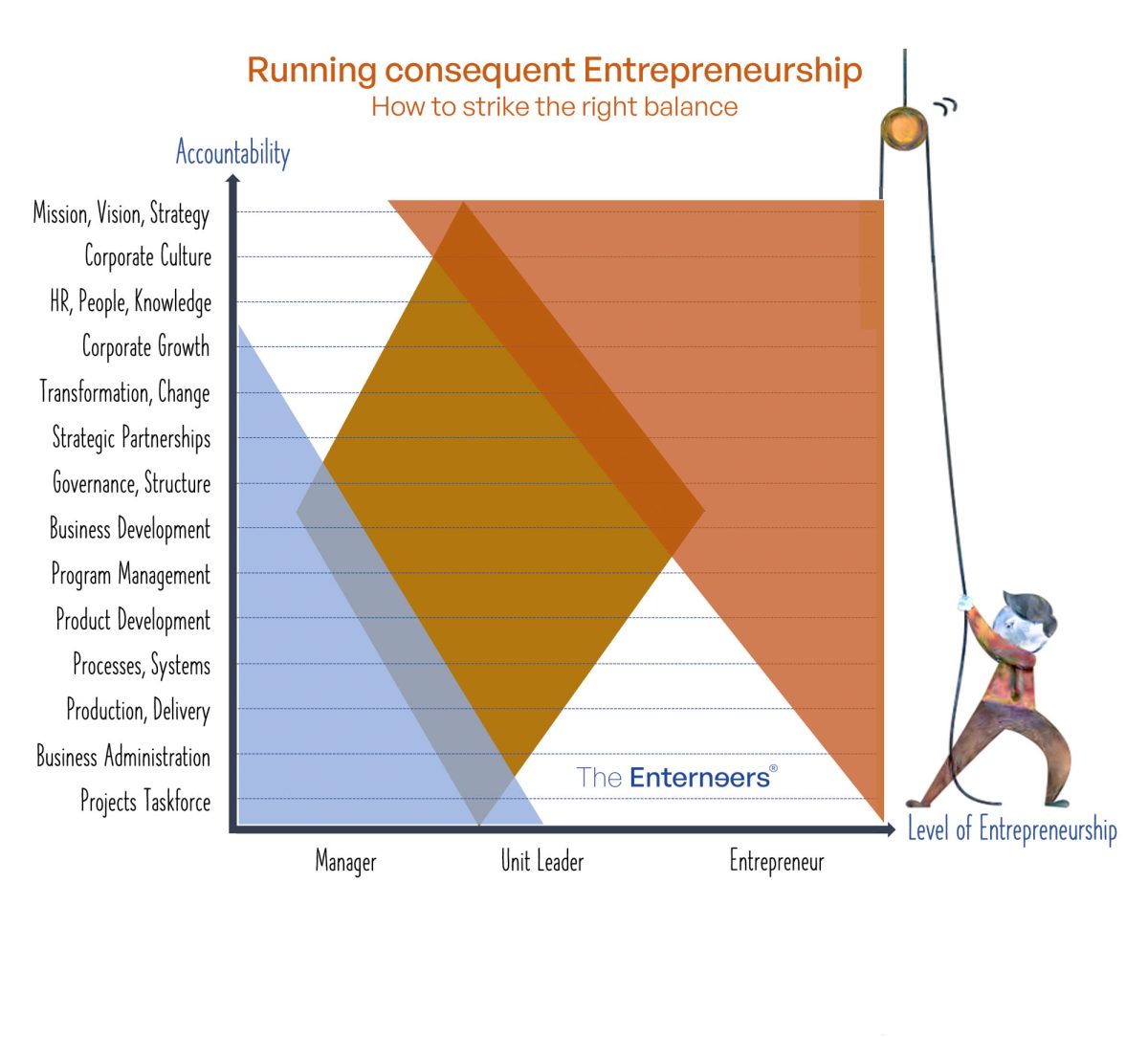
Why is it so important for business leaders to be able to distinguish between the roles of entrepreneur, leader and manager? Successful entrepreneurs focus on vision and strategy; they guide their employees and remove obstacles from the path to success, much as an athletic coach does.

Why is it so important for business leaders to be able to distinguish between the roles of entrepreneur, leader and manager? The search for the correct answer likely has to do first and foremost with the deductions we make from observing our own thinking and actions. The larger and more complex the business and, thus the company itself becomes, the greater the extent to which staff and systems interact in different workflows, and the more that external stakeholders are involved, the more significant these deductions become. In practice, it can be observed that companies that grow successfully are usually managed by executives who consistently focus on their appropriate, sustainable role within the company.

Successful entrepreneurs focus on vision and strategy; they guide their employees and remove obstacles from the path to success, much as an athletic coach does. In contrast, managers typically focus more on the execution of tasks within the business. Leaders, on the other hand, deal with the staffing, equipping, empowerment, motivation and development of staff and business units. When managers also act like entrepreneurs, with a corresponding far-reaching scope of action and decision-making, they are also referred to as ‘intrapreneurs’. For the sake of simplicity, in what follows, no distinction is made between intrapreneur and entrepreneur.

Executive leadership involves providing a compelling vision and clear direction. Successful entrepreneurs clarify priorities and expectations, define employee roles and ensure that the structures and resources employees need to accomplish their tasks are in place.

The presence and authenticity with which entrepreneurs lead are crucial to employee job satisfaction. To engage today’s workforce, entrepreneurs must focus more on leading than managing. Many employees are seeking coaches who can help them develop their strengths and capitalise on them to provide added value for the company. This is especially true when it comes to the younger generation. Entrepreneurial success is also determined by the will and ability of the individual to carry out this role within the company.

Leading an effective company means gaining distance from the day-to-day business and focusing on a clear strategy and vision – the "whats" and "whys". The "hows” should be left to the management and the team. If you’re used to triaging problems, putting out fires and managing from a reactive standpoint, this can be challenging. But, as I’ve learned the hard way, the ability to proactively light the way is a learnable skill.


Managers Execute, Leaders Lead and
Entrepreneurs Inspire the Larger Picture


One fundamental aspect of leadership is directing people’s attention. To do so effectively, entrepreneurs first need to focus their own attention. Only once they have done this should they turn their focus to others, eventually concentrating on the big picture.

Self-awareness is the basis of emotional intelligence. Listening to our inner voice and paying close attention to internal physiological signals is critical. This also includes our gut feelings, the so-called “somatic markers” or sensations that tell us whether something feels right or wrong.

One decisive criterion is authenticity – being the same person to others as you are to yourself. This makes it important to pay attention to others’ views of you – especially those people whose opinions you value and whom you trust to give you honest feedback – and assess your own authentic impact.

Another decisive factor is cognitive control. This enables you to pursue your goals regardless of setbacks and distractions. Effective cognitive control is exhibited by entrepreneurs who can stay calm in a crisis, resist becoming agitated, and bounce back from disappointments and failures.

Empathy is an essential element for being able to successfully perceive other people. Entrepreneurs who can effectively focus on others are those whose opinions carry the most weight. They are able to find common ground and make people want to work with them.

We can distinguish three types of empathy that are important for effective leadership: cognitive empathy (understanding someone else’s perspective); emotional empathy (feeling what someone else feels); and empathic concern (sensing what someone else needs from you).

Finally, having an outward focus will help an entrepreneur become a good listener and a good questioner. Strategic thinking involves looking for ways to exploit your current advantages while exploring new ones.

An often-mentioned challenge for entrepreneurs is the mastering and continual adjustment of the never-ending balancing act between operational constraints and the targeted tasks for the larger picture. It can be exhausting and energy-draining to constantly have to direct your attention to this "outer, upper corner" of the action matrix.

Simple things can often be helpful in becoming and remaining successful:

  • Establish core values and follow them. Many companies speak publicly about their core values, but these can be hollow words if the decision-makers at the top of the company are not authentically exemplifying these values and if they are not being operationalized in any way. The magic happens once core values are ingrained into employees’ daily work lives and are driving more autonomous decision-making.
  • Nurture your own professional development. Too often, entrepreneurs assume responsibility for everyone else on their teams except themselves. Although there are times when all of us need to manage, entrepreneurs are usually proactive; managers are reactive. To be an effective entrepreneur, proactively set aside time for your own professional development.
  • Delegate consistently and professionally, actively protecting yourself from burn-out. If you try to do everything yourself, you will inevitably see diminishing returns on the time you invest. Successful entrepreneurs spend most of their time on tasks that utilise their own unique skills and abilities and leave the rest to others who are more competent in those areas.
  • Beware of toxic people and structures. Actively cultivate a cooperative, people- and success-oriented corporate culture. Eliminate negative situations and possible sources of toxic developments as early as possible. Give appropriate priority and resources to active development of the corporate cultural.
  • Ensure that your company has an integrated and operationalised strategy and implement it. Make the meaning and purpose of the company as well as the value of every person who works there transparent.
  • Measure performance and success and regularly look to the "outer, upper corner" of the action matrix.

If you need support or training in some of the areas described above, don’t be afraid to admit this. Seek out appropriate support and multipliers from within your company. These tasks are simply too critical and momentous to be managed with less than complete success.

Über Unternehmertum, Führung und Management

Warum ist es als Unternehmenslenker so wichtig, zwischen den Rollen des Unternehmers, der Führungskraft und des Managers unterscheiden zu können? Erfolgreiche Unternehmer:Innen konzentrieren sich auf Visionen und Strategien und leiten ihre Menschen an und räumen Hindernisse aus dem Weg, ähnlich wie ein Trainer im Sport.

Warum ist es als Unternehmenslenker so wichtig, zwischen den Rollen des Unternehmers, der Führungskraft und des Managers unterscheiden zu können? Sehr wahrscheinlich geht es bei der Suche nach der passenden Antwort in erster Linie um die Ableitungen, die man aus den Erkenntnissen für sein eigenes Denken und Handeln trifft. Diese Ableitungen werden umso bedeutsamer, je größer und komplexer das Geschäft und damit das Unternehmen selbst werden. Je mehr Menschen und Systeme in unterschiedlichen Arbeitsabläufen im Unternehmen interagieren und je mehr externe Stakeholder eingebunden sind. Die Geschäftspraxis zeigt, dass erfolgreich wachsende Unternehmen in der Regel von Entscheidungsträgern gelenkt werden, welche sich selbst in konsequenter Art und Weise auf die jeweils geeignete und nachhaltig ausgerichtete Rolle im Unternehmen konzentrieren.

Erfolgreiche Unternehmer:Innen konzentrieren sich auf Visionen und Strategien und leiten ihre Menschen an und räumen Hindernisse aus dem Weg, ähnlich wie ein Trainer im Sport. Im Gegensatz dazu konzentrieren sich Manager in der Regel mehr auf die Ausführung, auf die Arbeit im Unternehmen. Von Führungskräften spricht man, wenn bei der betreffenden Position die Besetzung, Ausstattung, Befähigung, Motivation und Entwicklung von Menschen und Organisationseinheiten dominieren. Wenn Führungskräfte wie Unternehmer im Unternehmen agieren und sie einen dementsprechend weitreichenden Handlungs- und Entscheidungsraum haben spricht man im englischen Sprachgebrauch auch vom Intrapreneur. Nachfolgend wird zur Vereinfachung auf eine Unterscheidung zwischen Intrapreneur und Unternehmer verzichtet.

Bei der Führung von Unternehmen geht es darum, eine überzeugende Vision und eine klare Richtung vorzugeben. Erfolgreiche Unternehmer:Innen klären die Prioritäten und Erwartungen, definieren die Rollen der Mitarbeiter und stellen sicher, dass die für die Umsetzung erforderlichen Strukturen und Ressourcen vorhanden sind.

Das Wesen und die Authentizität, mit denen Unternehmer:Innen führen machen einen großen Unterschied für die Arbeitszufriedenheit der Mitarbeiter. Um die Mitarbeiter von heute zu motivieren, müssen sich Unternehmer:Innen überwiegend auf die Führung und weniger auf das Management konzentrieren. Viele Mitarbeiter suchen einen Coach, der ihnen hilft, sich weiterzuentwickeln und ihre Stärken optimal zu nutzen, um einen Mehrwert für das Unternehmen zu schaffen. Dies gilt insbesondere für die jüngere Generation. Über den Erfolg als Unternehmer:Innen bestimmen auch, der Wille und die Fähigkeit, diese Rolle im Unternehmen auszuüben.

Ein effektives Unternehmen zu leiten bedeutet, sich vom Tagesgeschäft zu lösen und sich auf eine klare Strategie und Vision zu konzentrieren, also das "Was" und "Warum". Dem Management und dem Team sollte das "Wie" überlassen werden. Das kann eine Herausforderung sein, wenn Sie es gewohnt sind, Probleme zu lösen, Brände zu löschen und reaktiv zu managen. Aber wie ich auf die harte Tour gelernt habe, ist es eine erlernbare Fähigkeit, proaktiv den Weg zu beleuchten.


Manager führen aus, Führungskräfte leiten an und
Unternehmer:Innen inspirieren das große Ganze


Ein grundlegender Aspekt der Führungsarbeit besteht darin, die Aufmerksamkeit der Menschen zu lenken. Um dies effektiv zu tun, müssen Unternehmer:Innen zunächst ihre eigene Aufmerksamkeit fokussieren. Erst danach folgt die Fokussierung auf andere Menschen und schließlich die Konzentration auf das Umfeld.

Unsere Selbstwahrnehmung ist die Grundlage der emotionalen Intelligenz. Es ist wichtig, auf die eigene innere Stimme zu hören und auf die inneren physiologischen Signale zu achten. Hierzu gehören auch unsere Bauchgefühle als sogenannte somatische Marker bzw. Empfindungen, die uns sagen, ob sich etwas richtig oder falsch anfühlt.

Ein entscheidendes Kriterium ist Authentizität als die Tatsache, dass man für andere dieselbe Person ist, die man für sich selbst ist. Deshalb sollte man auf die Meinung anderer über sich selbst achten und die eigene authentische Wirkung überprüfen, insbesondere wenn man deren Meinung schätzt und darauf vertrauen kann, dass sie ehrliches Feedback geben.

Zudem ist die kognitive Kontrolle ein entscheidender Faktor. Diese ermöglicht es Ihnen, Ihre Ziele ungeachtet von Rückschlägen und Ablenkungen zu verfolgen. Eine gute kognitive Kontrolle weisen Unternehmer:Innen auf, die in einer Krise ruhig bleiben, der Aufregung widerstehen und sich von Enttäuschungen und Misserfolgen erholen können.

Ein wesentliches Element für eine erfolgreiche Wahrnehmung anderer Menschen ist unser Einfühlungsvermögen (Empathie). Unternehmern:Innen, denen es gelingt, sich auf andere zu konzentrieren, sind diejenigen, deren Meinung das meiste Gewicht hat. Sie können eine gemeinsame Basis finden und die Menschen wollen mit ihnen zusammenarbeiten.

Wir können drei Arten von Empathie unterscheiden, die für eine effektive Führung wichtig sind: kognitive Empathie (die Perspektive des anderen verstehen), emotionale Empathie (spüren, was der andere fühlt) und empathische Sorge (spüren, was der andere von einem braucht).

Und schließlich hilft der Blick nach außen Unternehmern:Innen, gute Zuhörer und Fragensteller zu werden. Strategisches Denken bedeutet, nach Wegen zu suchen, wie man seine derzeitigen Vorteile ausnutzen kann, und nach neuen zu forschen.

Eine sehr oft beschriebene Herausforderungen für Unternehmer:Innen ist es, den ständigen Spagat zwischen den operativen Zwängen und der gezielten Arbeit für das große Ganze immer wieder auf ein neues zu meistern. Die eigene Aufmerksamkeit immer wieder in diese „äußere, obere Ecke“ der Aktivitätenmatrix zu lenken ist mitunter anstrengend und kräftezehrend.

Oft helfen bereits einfache Dinge, um dabei erfolgreich zu sein und zu bleiben:

  • Eigene Grundwerte festlegen und befolgen. Viele Unternehmen sprechen über ihre Grundwerte, doch handelt es sich dabei oft um leere Worte, wenn die Entscheider an der Spitze des Unternehmens diese nicht authentisch vorleben und sie in keiner Weise operationalisiert sind. Die Magie entsteht, wenn die Kernwerte im Arbeitsalltag der Mitarbeiter verankert sind und eine autonomere Entscheidungsfindung ermöglichen.
  • Pflegen Sie Ihre eigene berufliche Weiterentwicklung. Allzu oft übernehmen Unternehmer:Innen die Verantwortung für alle Mitglieder ihres Teams, nur nicht für sich selbst. Obwohl wir alle manchmal managen müssen, sind Unternehmer:Innen in der Regel proaktiv; Manager sind reaktiv. Um guter Unternehmer:Inn zu sein, sollten man sich auch proaktiv die Zeit für die eigene berufliche Entwicklung nehmen.
  • Delegieren Sie konsequent und professionell, schützen Sie sich aktiv vor Burnout. Wenn Sie versuchen, alles selbst zu machen, werden Sie unweigerlich feststellen, dass die von Ihnen investierte Zeit immer weniger wert ist. Erfolgreiche Unternehmer:Innen verbringen den Großteil ihrer Zeit mit Aufgaben, die ihre eigenen einzigartigen Fähigkeiten und Fertigkeiten nutzen, und überlassen den Rest anderen, die auf diesen Gebieten kompetenter sind.
  • Achten Sie auf toxische Mitmenschen oder Strukturen. Pflegen Sie aktiv eine kooperative und menschen- sowie erfolgsorientierte Unternehmenskultur. Beseitigen Sie Auswüchse oder Ursachen für toxische Entwicklungen möglichst frühzeitig. Räumen Sie der aktiven Kulturentwicklung in Ihrem Unternehmen einen angemessenen Stellenwert und Ressourcen ein.
  • Stellen Sie sicher, dass Ihr Unternehmen eine integrierte und operationalisierte Strategie besitzt und real umsetzt. Machen Sie Sinn und Zweck des Unternehmens und den Wert aller darin tätigen Menschen transparent.
  • Messen Sie Performance und Erfolg und richten Sie Ihren eigenen Blick regelmäßig in die „äußere, obere Ecke“ der Aktivitätenmatrix.

Stehen Sie dazu, wenn Sie in einigen der oben beschriebenen Punkte Unterstützung oder etwas Training benötigen und gewinnen Sie geeignete Unterstützer und Multiplikatoren im Unternehmen. Diese Aufgaben sind einfach zu wichtig und bedeutsam, um nur mit mäßigem Erfolg bewältigt zu werden.

Die Arbeit am Unternehmen anstatt darin

Die Praxiserfahrung zeigt, dass viele Unternehmer*Innen zu sehr mit dem Tagesgeschäft ihres Unternehmens beschäftigt sind. Das bedeutet, dass sie nicht genug Zeit für das nachhaltige Wachstum ihres Unternehmens aufwenden. In zahlreichen Fachbeiträgen ist von einer Falle zu lesen, wenn es Unternehmer*Innen nicht gelingt, mehr an ihrem Unternehmen zu arbeiten als darin.
Beim erfolgreichen Enterneering® (=Enterprise Engineering) dreht sich alles um die Arbeit am Unternehmen.

Was unterscheidet die Arbeit am und im Unternehmen?

Viele Unternehmer neigen dazu, mehr in ihrem Unternehmen zu arbeiten, statt an ihm. Zu viel ihrer Zeit wird von alltäglichen Aufgaben in Anspruch genommen, die eigentlich an jemand anderen delegiert werden sollten. Infolgedessen bleibt ihnen nur wenig Zeit für eine nachhaltige Unternehmensentwicklung, und ohne diese dringend benötigten Aktivitäten auf höchster Ebene wird das Unternehmen in seinen Wachstumsphasen eher zum Scheitern verurteilt sein. Beim erfolgreichen Enterneering® (=Enterprise Engineering) dreht sich alles um die Arbeit am Unternehmen.

Wir erklären Ihnen, was dahintersteckt und wie Sie vermeiden können, bei der Arbeit an Ihrem Unternehmen in diese Falle zu tappen.

Um einen besseren Eindruck vom Unterschied zwischen der Arbeit in und der Arbeit an Ihrem Unternehmen zu erhalten, finden Sie in der nachstehenden Tabelle einige Beispiele für Aufgaben, die "Arbeit IN Ihrem Unternehmen" und "Arbeit AN Ihrem Unternehmen" darstellen.


Wer führt eigentlich Ihr Unternehmen, während Sie die Arbeit der anderen machen?

Verbringen Sie noch viel Zeit damit, konkrete Aufgaben, Projekte, Kunden oder Aufträge zu bearbeiten, also mit der Arbeit im Unternehmen? Oder überwiegt bei Ihnen die Arbeit am Unternehmen, also an strategischen Partnerschaften, komplexeren Strukturen, zukünftigen Unternehmensorganisationen und vor allem an den weichen Elementen Mensch und Kultur?

Wie erfolgt effektive Arbeit am Unternehmen?


Unternehmer*Innen, welche diese Form der Arbeit am Unternehmen erfolgreich umsetzen betreiben aktives und kein reaktives Enterprise Engineering (=Enterneering®). Erfahren Sie hier mehr über die erfolgreiche Implementierung von Enterneering®

Working On versus In Your Business

The professional experience shoes, many entrepreneurs are too involved in day-to-day operations of their business. This means that they don’t spend enough time trying to sustainable grow the business. Numerous professional articles speak of a trap when entrepreneurs fail to work more on their business rather than in it.
Successful Enterneering® (=Enterprise Engineering) is all about working on the business.

What’s the Difference Between Working IN & Working ON Your Business?

Many entrepreneurs tend to work more in rather than on their company. Too much of their time is taken up by day-to-day responsibilities that should be delegated to someone else. As a result, they are left with limited time for sustainable business development, and without these much-needed top-level activities, the business is more likely to fail in its growth phases. Successful Enterneering® (=Enterprise Engineering) is all about working on the business.

We explain what is behind it and how you can avoid falling into this trap in working on your business.

To get a better impression about the difference between working IN & working ON your business see the table below for some examples of tasks that represent “working IN your business” and “working ON your business”.


Who actually runs your business while you do the work of others?

Do you still spend a lot of time working on concrete tasks, projects, customers, or contracts, we mean working ‘in’ the business? Or is your work predominantly ‘on’ the business, like on strategic partnerships, more complex structures, future corporate organisation and above all on the soft elements of people and culture?

How to Work ON Your Business Effectively?


Entrepreneurs who successfully implement this form of work on the company are practising active and not reactive enterprise engineering (=Enterneering®). Learn more about the successful implementation of Enterneering®